Wednesday, July 04, 2012
The Encampment
I was lucky to catch The Encampment-- a massive temporary public art piece by artist collaborators (as well as a huge number of contributing artists) Thomas+Guinevere a couple of weeks ago at Fort York. 200 tents were placed on the grounds of Fort York-- site of The War of 1812-- which served as individual sites for artistic interventions. The project's handout explained that each tent installation was inspired by real individuals living in the Canadas during the war. As compelling as some of the tent installations were, for me the real power in the installation was the sight of the 200 tents together on a historic site against the backdrop of the changing city.
Though the tents were (for me) a thoroughly engaging evocation of Canada's history, I can't help but also see them a bittersweet metaphor for my own vague alienation and feelings of displacement in the city I was born in as it changes more everyday.
Labels:
architecture,
events,
installation,
psychogeography,
public art
Wednesday, June 27, 2012
Burning Schoolhouses
Just in time for Canada Day...fireworks! I'm happy to announce that I'll have some work up in an exhibition that will be a part of the Planet IndigenUS Festival in August. The festival will take part mainly at Harbourfront Centre, but also at partner institution Woodland Cultural Centre in Brantford, Ontario. The exhibition is a showcase of the work of students of the Aboriginal Visual Culture program at OCADU. I am not in the Aboriginal Visual Culture program myself, but I'm grateful to have been invited by department head and incredible artist Bonnie Devine to take part anyway. My piece is called Burning Schoolhouses-- more on them below.
Burning Schoolhouses, 2012
Fireworks, Japanese Kozo paper and adhesive
Installation dimensions variable
Each unit approximately 15cm X 14cm X 6cm
Burning Schoolhouses is a series of sculptural multiples inspired by the essay Confessions of a Born Again Pagan by Fred Kelly. The multiples employ the use of the classic firework, The Burning Schoolhouse, to explore the explosive issue of residential schools just over fifteen years after the last residential school in Canada was closed in 1996. The objects simultaneously connote a sense of celebration, violence and catharsis while embodying the complex and painful process of reconciliation for both aboriginal and non-aboriginal Canadians.
Thursday, June 14, 2012
Toronto Life
Two-colour Risograph prints on archival cardstock made in collaboration with JP King of Paper Pusher Print Works. These drawings will be on the upcoming School Jerks 12", due out in a matter of weeks.
1) Thanks, JP!
2) Prints can be purchased here.
Labels:
drawing,
illustration,
paper,
print,
printed matter,
punk,
rock'n'roll
Tuesday, June 05, 2012
Thursday
Lots happening this Thursday! First off, as I mentioned in a previous post, I'll be taking part in the exhibition Under 30 at 30 at the Japanese Paper Place's warehouse space on Brock Avenue. All day Thursday, the JPP will be celebrating their 30th Anniversary with an open house, exhibition, paper sale and heaps more. The exhibition opens in the evening...come out and support this singular Toronto institution in the process.
Japanese Paper Place - 30th Anniversary Celebration
Thursday, June 7, 2:30-9:30pm
77 Brock Avenue, Toronto
http://www.japanesepaperplace.com
Later that night, there will be a legal fee benefit event for my good friend, fibre artist Lizz Aston at The Piston, on Bloor Street West. Lizz was falsely accused of assault when someone ID'ed her to the police using Facebook, resulting in her unlawful arrest...! Unbelievable! I am donating the piece pictured above, A Breast, for the event's art auction. The night should be a blast, with dancing, crafty art and live music by psych/pop locals The Whirly Birds, The Persian Rugs and Hollow Earth, who I've been meaning to check out for ages.
For more info on the event, look here.
Labels:
events,
exhibitions,
food,
fun,
paper,
rock'n'roll
Tuesday, May 15, 2012
Under 30 at 30 at The Japanese Paper Place
My recent piece, A History of Hunger, will be shown at the Japanese Paper Place's upcoming exhibition Under 30 At 30, which will open during the first week of June. The exhibition is a small part of the JPP's 30th anniversary festivities, which will include a paper sale, workshops, an open house and more. They are such a unique local institution and I rely on them for project supplies frequently--I'm so glad they exist!
For more info on the JPP's 30th anniversary, look here.
Wednesday, May 09, 2012
School Jerks 12" Art
I've been busting my hump for the last week on drawings for the School Jerks 12", which is due out very, very soon. I'm down to the last two drawings and am really losing steam...! I'll be producing a 11"X17" 3-colour poster of all 17 or 18 drawings for the record in collaboration with Paper Pusher Print Works within the next few weeks. Very exciting stuff!
Tuesday, May 01, 2012
Rochester Trip
Took a quick trip across the pond to Rochester, New York last week. The weather was sort of craptastic (mostly cold and damp), but it was a really cool trip nonetheless. Rochester is a tiny city, with lots of neat art deco/art moderne architecture. The Kodak Building, the firehall on Chestnut Avenue and this old Chevrolet dealership (?) turned coffee shop in downtown Rochester's east end were highlights, for sure.
While I was there, I managed to take in a lot of art in both expected and unexpected places. I went to the George Eastman House (Eastman was founder of Kodak, which is based in Rochester) which is a museum of photography and film situated in an old ivy-covered mansion. There was an exhibition up which featured a number of photographic medallions from the early 20th Century such as the one above (scooped from the George Eastman House Flickr page). There was another small exhibition called Ballyhoo, which focused on promotional materials and signage from the golden age of film and was particularly neat. The one thing that irked me about Eastman House was it's lack of wayfinding information-- after leaving, we realized that we had missed two of the museum's exhibitions entirely. Rats!
One of our other stops was the Rochester Contemporary Art Center, which had a great show up called Work It: Artists Address Labour and Unemployment. It was nice to see pieces from Kathryn Clark's Foreclosure Quilt series up in this show, which I had only previously seen through images online. Also got to meet the gallery's plucky Director, who introduced himself and chatted for a while. Nice dude! Don't think that's ever happened to me in Toronto...!
Our first night there, we ventured into the amazing abandoned Rochester Subway tunnel with the friend we were staying with armed with only a single flashlight and about $10 (goes a long way in the U.S.) worth of alcohol . Apparently people go down into the tunnel all the time to explore-- there was a ton of graffiti down there. The above patch was particularly unusual.
This trip to Rochester made me miss Baltimore quite a bit, and reminded me how much smaller American cities have to offer. Canadians generally want to go to places like New York City and San Francisco on vacation-- understandably so, but smaller American cities seem to really have their own unique identity and a slew of neat things to check out that can be found pretty easily. I'm looking forward to going on more quick and dirty trips like this just south of the border in the future-- next up is Detroit, hopefully.
Labels:
architecture,
craft,
fibre art,
galleries,
labour,
museums,
photography,
public art
Monday, April 16, 2012
Parallax Scroll at Harbourfront Centre
Went to Harbourfront's York Quay Centre on Saturday to check out this season's exhibitions before they closed on Sunday night. While I went expecting to get a bang out of the craft department's biennial, LOOK Out (and don't get me wrong, I did...), I was completely blown away by Scott Carruthers' drawing installation, Parallax Scroll. An immersive barrage of image and text reminiscent of R. Crumb or Lee's Palace muralist Al Runt, Carruthers' intense drawings reminded me of amazing punk album art. It also made me think of the internet...except more honest.
Favourite exhibition visited in a very long time. Thanks, Scott!
Labels:
art heros,
comics,
drawing,
galleries,
typography
Thursday, April 12, 2012
Busby Berkeley
I'm working on my second-to-last assignment for school right now on Busby Berkeley's choreography for depression-era musicals, for a seminar class on the topic of Beauty. The choreography really is a feast for the eyes, which involved not so much dancing as it did posing and the movements of chorus girls in unison and shot from above to create some pretty dazzling living patterns.
In a 1998 documentary called “Going Through The Roof,” Busby Berkeley’s dance routines were described as the “Epitome of Broadway Modernity." Best known for his choreography in depression-era “talkies” such as Footlight Parade, 42nd Street, Dames and Gold Diggers of 1933, Berkeley’s elaborate routines involving the synchronized movements of chorus girls and revolving stages were crowd-pleasing, ground breaking and highly influential-- echoes of them can be seen in everything from advertising to music videos of the late 20th Century.
Providing some of the context that surrounded Berkeley’s choreography is important to a reading of his work. Berkeley’s signature work can be seen in films made between the two world wars during the years of the Great Depression, and he was at his most prolific in 1933-- widely believed to be the worst economic year in US history. Interestingly, despite the depression movie attendance was at a high, and depression-era audiences were most attracted to feel-good, codified genres. On a related note, central to the character of Berkeley’s choreography are synchronized, machine-like series of movements that feel rooted in Taylorist and Fordist principles of standardization and assembly line production such as harmony, anonymity and perfection. A veteran of World War One, many of Berkeley’s ideas also came from military drill formations.
Above: "We're In The Money" from Gold Diggers of 1933, featuring Ginger Rogers.
Monday, April 09, 2012
City of Craft Spring
Tara has been DJ-ing around town for 7 years, and has done numerous guest sets on radio. Past monthly nights included Out of Vogue (2005-06) and Girls Go Crazy! (2010-11) and her new monthly night Strange Notes will begin at the Embassy in Kensington Market in March of 2012, and will continue on the first Wednesday of every month. For City of Craft's spring show, Tara will be ringing in the sunshine with some sweet pop, rock, bubblegum and psychedelia from the 1960s. There will be three live sets over the course of the day on glorious vinyl! Think Beach Boys, Girl Groups, fun pop hits that you know and cool lost nuggets that you don't know! Rave on!
Needless to say there will be a ton of fantastic vendors of craft and rummage at this show-- among them my pals Sweetie Pie Press, Old Weston, Krystal Speck and tons more. Don't miss it.
City of Craft Spring
Trinity St. Paul Church
427 Bloor St. West
Toronto
April 21st, 2012
11am - 6pm
$1 Admission
Labels:
craft,
events,
rock'n'roll,
sales
Friday, April 06, 2012
Slow Art Day at the Textile Museum of Canada
I am proud to announce that the Textile Museum of Canada has invited me be their host for Slow Art Day 2012. Haven't heard of Slow Art Day? Don't worry, I hadn't either until they asked me to help them out with it...
Slow Art Day is a worldwide event that will take place around lunchtime on April 28th. Guests are invited to pay admission to their local participating museum and take their time looking at four or five pre-selected objects from the museum's current exhibitions. After an hour or so, guests will then gather somewhere for lunch and casually discuss their thoughts about the work. The point is to take some time to unplug, relax, enjoy yourself, and appreciate some glorious examples of art, craft and creative genius from around the world. The point is also to gather and talk about art-- no experience required!
On the 28th, we will be viewing objects from the TMC's current exhibitions: Portable Mosques: The Sacred Space of the Prayer Rug and Perpetual Motion: Material Reuse in the Spirit of Thrift, Utility and Beauty. For more information on these exhibitions, check out the Textile Museum's website. Objects will be announced to registrants within the next week or so.
After viewing the objects, guests will meet on the TMC Mezzanine for lunch and discussion. I was thinking in addition to bringing your own lunch, it would be nice if everyone could bring something edible to share with the group potluck-style, if possible. Also, feel free to bring along any textiles or objects you own that employ reused materials in an interesting way for discussion and admiration.
Preregistration is required-- you can do this here:
http://slowarttmc2012.eventbrite.com/
Hope to see some of you there! Also, please spread the word!
Image: Indigo Robe from Nigeria (detail), 20th Century
Monday, March 26, 2012
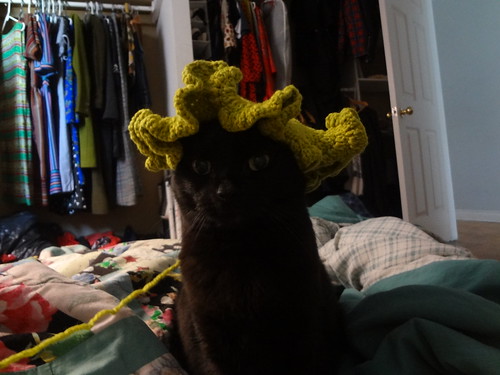
Hyperbolic Cat Wig
Monday, March 12, 2012
A History of Hunger

Here a is new-ish project I completed recently called A History of Hunger consisting of one dozen mini-scroll "books" made of a dozen white eggs. Admittedly, this was a project for school. Here's a statement about it...sorry if it comes across as a little clinical sounding.
A History of Hunger
Eggshells, Japanese paper, adhesive, egg carton
Edition of 12 unique objects
A History of Hunger is a series of 12 miniature objects inspired by books. Using the phrase “break in case of emergency” as a starting point and combining creative writing with research and sculptural processes, I used broken, empty eggs to frame an exploration of hunger and famine across time and space. Through online research, I learned about both contemporary and historical examples of famine and food insecurity such as the Irish potato famine as well as periods of hunger during communist rule in China, WWII and the Great Depression. Each of the twelve book-objects represents a year when a famine or food shortage existed somewhere in the world, and contains a short poetic response to a condition or situation that I read about. A guiding idea in the series is that in opening each egg and finding it empty aside from a short piece of text reflecting an experience of hunger or famine, one might learn not only how widespread hunger is, but how people have coped with food shortages, as well as how they come to exist.
This project is in keeping with the guiding principle of our class publication-- playing with time by imagining the present through the lens of the future, and guessing what aspects of our contemporary cultural/societal condition will carry over to become major issues in subsequent decades. Food security is an issue worldwide that will likely only get worse with increasing climate change. The series of multiples resists providing a linear narrative or definitive history of hunger, and the inclusion of a multiple marked with the year 2042 alludes to the fact that hunger will likely be a continuous problem in a rapidly growing and warming world.
Many of the material/formal decisions I made in the execution of A History of Hunger grew out of my initial decision to use a carton of broken eggs as a starting point. While the content of the multiples is historical, the use of a contemporary carton of eggs marked with nutritional information at a recent date stamp root the work in the present. The multiples play with the scroll-- a historical format that is echoed in word processing applications, web browsers and film credits. Typing directly onto the narrow scrolls required the use of short words in my poetic responses to each historical example of hunger, making them resemble Haikus and giving them a quiet quality that softens the tragic imagery contained in some of the text. The long scrolls made out of Japanese Kozo paper were designed to mimic the look of egg yolks and whites pouring out of their shells. Finally, the fragility of the eggshells fits with the precariousness of food security across time, as well as the increasing instability of our environment.
Saturday, March 10, 2012
Miscellaneous News
Promotional Image for Everything Under the Moon (2012)
I've have so, so, so much to catch up on here, seeing as I've been completely and utterly loaded down with school work for the past month at least. Boy, am I looking forward to the summer, when I'll have the chance (hopefully) to blog more, make some new work, and have time to think about (or should I say linger on...) the things I see and do.
A few weeks ago I was lucky enough to see Everything Under the Moon at the Enwave Theatre performed by Shary Boyle and Christine Fellows. A nostalgic combination of theatre, song, overhead projections and shadowplay, the performance was rooted in a playful yet melancholy story about a honeybee and a bat and their fight against extinction. The music was perfect for the fable-- Christine Fellows' brand of rootsy-folk accompanied by cello and percussion was part Feist and part Fred Penner (well, that may be a stretch, actually...!). While the narrative at the root of the performance was picked on a bit in a review or two terms of it being a little sketchy and underdeveloped, I liked the fact that it was quirky and had an oddball, almost surreal quality to it that at times contained a surprising mix of humor and sadness. I feel like all of my favourite things in the world walk this fine line, come to think of it...
For me, the highlight of the performance was hands-down Boyle's magical use of the overhead projector. During a part of the performance, Fellows sang a verse about the first encounter between the story's protagonists, Idared the honeybee and Limbertwig the bat while Boyle slowly peeled away about five layers of transparencies that featured head-on illustrations of the anthropomorphic little critters. As the layers were peeled away, the two characters became more and more human-- hard to describe and do justice, but it was visually moving to the point that I was reduced to tears. There were other points in the performance where the projections were particularly poignant, too-- I can't help but connect this poignancy to the use of a "lost" or obsolete technology animating a narrative about the loss of living things through extinction. Pretty amazing.
Lots of other news to report as well, but maybe I'll save it for other posts. On the topic of obsolescence and old-ish technologies, I thought I'd post this poster (0% Photoshop, might I add...) I made for my new solo DJ night at The Embassy Bar in Kensington Market. I usually try to compartmentalize my various lives and try not to talk about music geek stuff too much on this blog, but this poster is definitely inspired by the projected light shows of the hippie era that Boyle is referencing at least a wee bit in her work. Part of this new night is that the music will be accompanied by new projections every month. Last Wednesday, I projected the Monkees' movie, Head on the wall next to the DJ set up. Next month, who knows. Gothic horror? Primitive, early animation? I'm still thinking about it.
Labels:
animation,
art heros,
design,
performance,
printed matter,
rock'n'roll
Monday, February 20, 2012
Amy Borkwood Interview on TCA

Amy was my subletter while I was in Baltimore! She is also an accomplished bookbinder, longtime zine maker and all-round awesome person. I interviewed her recently for Toronto Craft Alert-- in it she talks about how she has integrated zines into her job as a community worker. Mega inspiring stuff.
http://torontocraftalert.ca/2012/02/16/questions-for-crafters-amy-borkwood/
Labels:
activism,
books,
feminism,
journalism,
printed matter,
zines
Saturday, February 11, 2012
Zine News

1. My latest zines, the first issue of Goin' Down The Road: Newfoundland Stories of Leaving and Museozine are now up for sale in my Etsy Shop for anyone who's interested in picking up a copy by snail mail.
2. On the flip side, locals can now pick up copies of either zine at local art shop No Show Exhibits, which is a part of Katharine Mulherin's Queen West art empire of amazingness. The shop can be found at 1082 Queen Street West, just east of Dovercourt.
3. Said zines will be traveling all the way to Halifax, where they will be both exhibited and for sale in Eyelevel Gallery's Reshelving Initiative 5 exhibition. You can learn all about it here.
4. Finally, there is no confirmation on this yet, but I'm hoping to table OCAD's very own zine fair, happening at the end of the month. Once I know that I have a table reserved, I will post more specific info about this as soon as I can.
Labels:
etsy,
exhibitions,
printed matter,
shops,
text,
zines
Friday, February 10, 2012
First Art Purchase

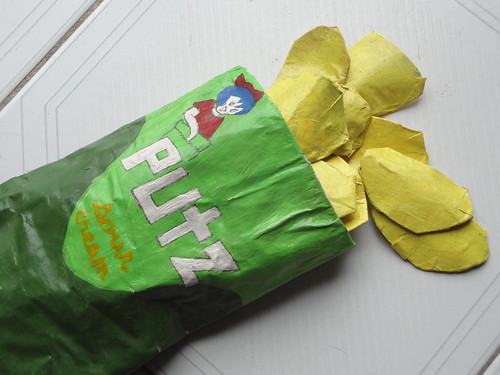
I am unbelievably excited to announce that I've made my first major art purchase! It's a 'Putz' bag of chips sculpture by the artist STO, inspired by the regional chip brand Utz from Pennsylvania. Utz chips were a staple in Baltimore-- they were everywhere there, and we ate a boatload of them. So this is a super cool joint Valentine's gift for us, financed mainly with my own art sales at Katherine Mulherin's new-ish Queen West art shop, No Show Exhibits.
The chip bag was originally included in a New York exhibition called My Slow Called Life in NYC at Mulherin Pollard Gallery. For the show, STO recreated his entire apartment in paper mache. Photographs of the installation can be found here on STO's blog.

Here is Ben wishing these were a real life bag of Utz' Crab flavoured chips, a Baltimore favourite of ours...either that or Carolina-Style BBQ...
Friday, February 03, 2012
Columns and Swoops

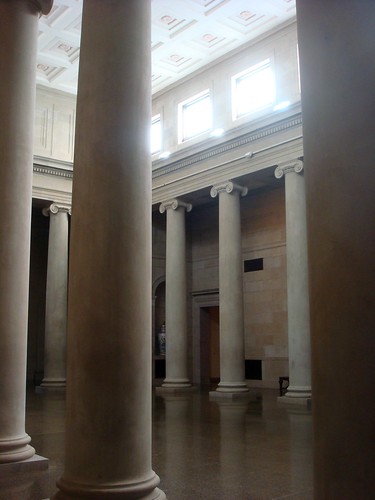
Somewhere along the line-- during my time in the States, most likely-- I turned into an architecture gawker. In the States, I went to museums and felt that I could admire the architecture without having my enjoyment of it be tainted by a certain degree of bitterness about the politics and astounding prices that are par for the course among (many, but not all) Toronto institutions.
Looking at these photos, it dawned on me how cool it would be to make a big series of pictures like this. I'm hoping to make it out to the DIA in Detroit later this month, so we'll see if I can add a new photo to the pile that soon.
Fox Court, Baltimore Museum of Art, Baltimore, MD
Looking up at the Museum of the American Indian, Washington, DC
Central Court, The Walters, Baltimore, MD
Tuesday, January 31, 2012
Charles Ledray

Charles Ledray is a Seattle-born artist I became interested in while working at the Textile Museum last summer. I've been bogged down with school stuff for the past week and haven't posted anything in a while, so here is a little piece I wrote for an assignment about the work pictured above entitled workworkworkworkwork, first exhibited in 1991. FYI: I will be building a "fantasy exhibition" of sorts around this work for a curating class.
*
Charles Ledray
workworkworkworkwork, 1991
588 objects: Fabric, thread, cotton batting, yarn, embroidery floss, nylon cord, carpet, leather, wood, metal, foil, metal chain, wire, nails, porcelain, pumice, beads, buttons, cardboard, corrugated cardboard, paper, magic marker, paint
Approximately 13.7 m x 25.4 cm x 5 cm
Private Collection, Houston, TX
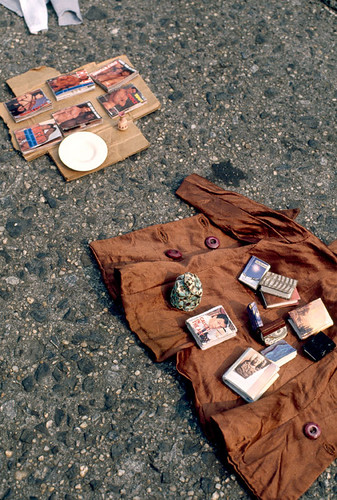
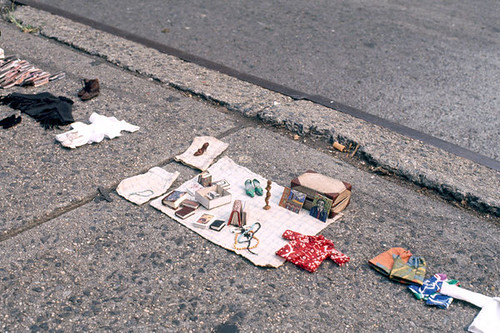
Charles Ledray is an artist working primarily in the area of fibre-base sculpture and installation. His work is characterized by labour-intensive and somewhat obsessive tendencies towards hand making. A compelling blend of high-art and craft, his best-known works are installations comprised of handmade men’s suits, hats, fantastical garments and ceramic vessels that play with multiplicity and scale. In his installation workworkworkworkwork (1991), 588 miniature objects-- among them garments, magazines, housewares and multiple pieces of art-- were displayed in New York’s Astor Place in the form of an impromptu street sale. Each of the objects was painstakingly hand-crafted by Ledray, and their presentation on a busy sidewalk-- often splayed across shrunken replicas of flattened cardboard boxes and rumpled raincoats-- cleverly blurred the lines between art and mass-produced object. The individual objects themselves are an enigmatic combination of abjection and whimsy, like a half-inch dildo in a dollhouse.
Both the presentation and objects of workworkworkworkwork evoke a number of responses in the viewer. The lack of human presence in the installation causes the objects to convey a sense of melancholy and loneliness, imploring one to piece together biographical details of the hypothetical owners of each cluster of tiny belongings for sale. The objects are reminiscent of toys or props-- accessories for a Ken doll whose dream house was foreclosed and who is drifting from fleabag hotel to fleabag hotel. Each object straddles the line between precious and imprecious, with grasshopper-sized hardcover novels standing spine up as if tossed aside among real cigarette butts on the sidewalk. The centrality of labour is evident in the work, from Ledray’s labour to the title of the work to the work of people who labour to make mass-produced objects in sweatshops that move from multi-national chain store to church sale to sidewalk vendor to landfill. Finally, the piece’s presentation on a public sidewalk is dependent on the presence of the pedestrian to complete the work. This brings to mind how members of dominant society-- in the case of workworkworkworkwork, the Manhattan white-collar worker, socialite, window shopper, or tourist-- view people on the margins of society. The homeless, street vendors and people performing menial jobs are relegated as background players against an urban backdrop, always viewed peripherally. The miniaturization of the objects in workworkworkworkwork poignantly reflects this.
While it is easy to get completely caught up in the sense of wonder and delightful seediness of Ledray’s tiny sculptural stand-ins, a key to the work’s success lies in its presentation in public, on a sidewalk in a huge metropolis that dwarfs everything it contains. Situated in Manhattan-- an iconic American city which has long been seen as a centre of commerce, immigration, power and consumption-- workworkworkworkwork interacts with its site’s impressive web of history, from deadly industrial disasters in garment factories and riots fuelled by class resentment to the economic and social conditions of New York City in 1991 when workworkworkworkwork was first exhibited. The relationship between the objects-- which despite their scale evoke personal histories that feel very real-- and the site activate something much larger than the diminutive objects laboured over by Ledray: a greater social history of a city that lies deeper than a sidelong glance during a brisk walk across a crowded intersection.
Photos courtesy of the Whitney's website: http://whitney.org/Exhibitions/CharlesLeDray/Images
Labels:
art heros,
fibre art,
installation,
labour,
public art,
sculpture
Tuesday, January 10, 2012
Museozine

I completed my latest zine exactly a week ago, making my collective zine output total a whopping four zines-- two were collaborations, and two were my own-- in 2011, the official year of the Revenge of Print. Looking back, I feel that I did well...I did my part for the revenge! Print was one of my first loves. Needless to say, I hope it is here to stay.
While this zine came to fruition mere days into 2012, I consider it a '2011' zine because so much of its research and construction was done in 2011. In a nutshell, Museozine is a zine of interviews with friends of mine-- all wonderfully creative young people who craft, make music and make art on their own terms-- about their museum experiences. These interviews started off as casual research I was doing for my job at a small Toronto museum last summer. The interviews were, in some cases, so honest and joyful and surprising that I felt like I just had to publish them in zine form as a way of honoring and preserving them.
Some of my favourite moments in the zine include the following quotes:
"When I was a young kid I loved to sit upside down on the couch (legs up the wall, head hanging down over the end of the seat) and look at the living room/kitchen upside down and fantasize about how cool it would be to be able to walk around in a house that was upside down. Really upside down, but defying gravity so everything would stay in its place, and to walk in the front door and try to navigate around the house that way and see all the familiar objects in this whole new way. I did this a lot. It was a bit of an obsession. There's my dream museum-- my childhood home upside down." --Elaine B.
"If I could create my own museum it would be quite a bit like my own apartment, except much, much bigger...everything from old print (magazines, comic books, fanzines, old books) to old toys, various pop culture items, guitars and music gear, and-- probably most importantly-- vinyl records." --Matt H.
"I think a hobo museum would be cool. It would have a riding the rails simulator, and a hobo camp staffed with historical re-enactors like Black Creek Pioneer Village, and maybe a folk singer from the 20s or 30s. Although this is changing, museums tend not to represent the lives of people on the margins of history." --Patrick M.
Today, headlines about millions of dollars in funding for culture and research being cut from both the municipal and the provincial budget over the next year were splashed across Toronto papers. Sad when you consider how much museums have captured the imaginations of the people I interviewed. Most of these interviews referred to childhood museum experiences, which, for the case of many, happened in the 1980s, before the massive culture funding slashes and economic recession of the very late 1980s and early 1990s. There is currently an accessibility problem among Toronto's museums. I hate to think that the current economic climate and recent cuts will make the current problem (or crisis, even) of local museum accessibility--and not to mention cultural funding-- even worse.
For lots of impassioned writing on the topic of public access to museums and cultural institutions, check out Toronto critic and arts writer Leah Sandals' always engaging blog, Unedit My Heart.
Monday, January 09, 2012
Danville Community Encyclopedia

A few days ago, I finished my latest zine, Museozine. This got me thinking about how artists have used the interview format in both performance and printed matter. Tonight in my Publications class I was introduced to a really awesome example of this (somewhat minor) tradition called the Danville Community Encyclopedia by artist Anna Callahan. For this project, Callahan hung out in a public library in Danville, Illinois interviewing members of the public of all ages about their respective areas of expertise. She eventually filled an entire book with transcriptions of the interviews she collected-- the encyclopedia entries as diverse as Ghostbusters, Gospel Songs, Attention Deficit Disorder, Protest, Chicago Illinois, Canada and Tupac.
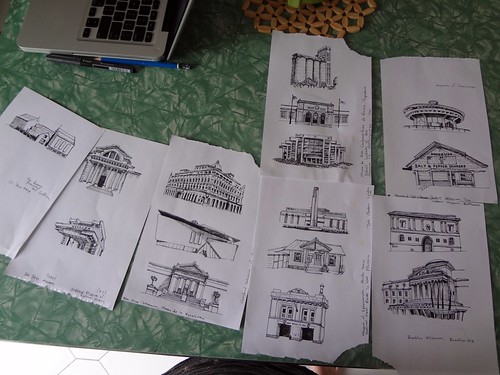
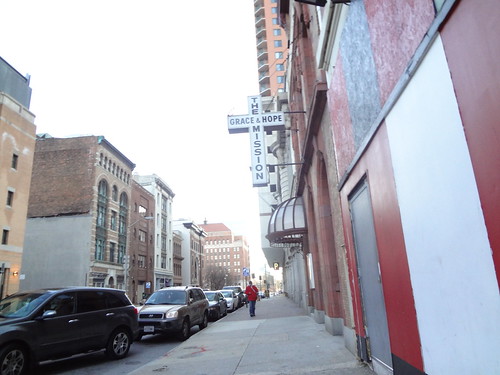
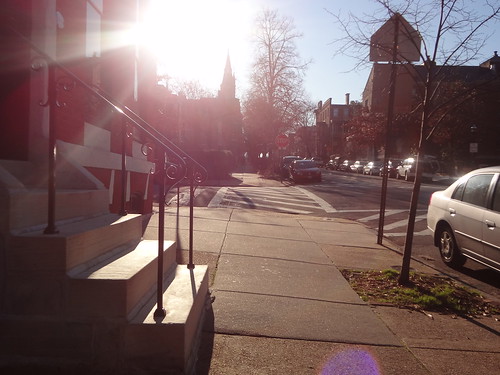
This was an uber-limited edition. I wish I could buy this!
For more on Anna Callahan and her community projects, check out her website.
(P.S: This is my 300th post!)
Labels:
art heros,
books,
community,
journalism,
multiples,
performance,
printed matter
Monday, January 02, 2012
16 Museums
Sunday, December 18, 2011
Crime Map Walk

Here are some photos from my final project for my Performance Art class. The following text is my short artist statement about the project.
Crime Map Walk
Performance documentation from 10.12.11
Video, laptop, paper, pins
This performance is inspired by the idea of the artist as traveler, responding to the city they find themselves in as well as walking tours and maps. Its jumping off point was an online “crime map” of Baltimore, which one can consult to find an up-to-the-minute map and information indicating the locations and types of crimes committed across the city. Before coming to Baltimore, I found myself browsing such maps as a way of attempting to distinguish between the “good” and “bad” parts of the city. As any long-time resident of Baltimore knows, it is quite difficult to make such a distinction here, where there is a fairly high crime rate city-wide.
For this performance, I used the Baltimore Crime Map (http://crimebaltimore.com/) to trace a walking path between my house in Charles Village and a main intersection in the Inner Harbour. I then walked this long path, trying to pass as many sites of recent crimes as possible, taking photo-documentation in the form of over 100 photographs taken every half-block or so along the way. These photographs were then turned into a stop-motion style video, which serves as the main document of the performance.
This performance plays with the idea of how people respond to crime and fear in an urban environment. As a defense mechanism, many people avoid areas they feel are “bad” in their day-to-day travels. This performance reverses this logic, and in doing so, faces certain fears of crime head on. Also, in performing this walk on a Saturday during the holiday season, I realized that hardly anyone was walking around on the streets I walked during my journey. This performance also attempts to address the importance of street life and pedestrianism in keeping cities both lively and safe.
Tuesday, December 13, 2011
That's All Folks!


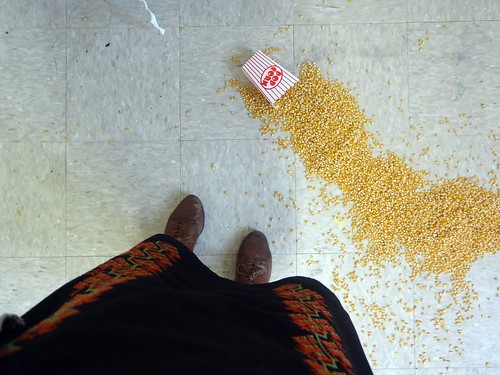
Installation with popcorn kernels, uniform and props, completed last week. I've never put popcorn kernels on a wall before...now I know it's possible!
I think this piece is a distillation of a lot of the feelings I've had and things I've seen while visiting the States. Most of all, I think it is about how history moves from one period of time to the next, and about the feeling that things are about to change. It is also about the loss of illusions.
One of my favourite movies of all time is The Last Picture Show, which I couldn't help but think of as I was thinking up this piece, as well as thinking up the performance I did in McKeldin Square a few months ago. While the film's trailer focuses a little more on the torrid affairs between the residents of the fictitious town, Anarene Texas, the movie is set during a time when the movie theatre was beginning to play less of a role in people's lives because of the home television set.
Also on the topic of the movement from one historical period to the next, I read the following quote in a class recently, written by the American art critic Martha Schwender on the use of appropriation in the work of the artist Sherrie Levine. It excited me because it questions whether or not we are nearing the end of a long period of overarching irony/cynicism in contemporary art...or perhaps also a period plagued by a sense of cynicism in general?
Appropriation rose out of this desire to have it both ways, to keep what you loved-- or at least knew intimately-- and still make art. It was a great solution. But I was born in the 1970s, following the burnout of the 60s, and it has run aground in recent years. Not only have artists like (Sherrie) Levine, Jeff Koons and Richard Prince been dragged through the legal system for their cultural borrowing, but the postmodern irony and cynicism on which Appropriation was founded also feels outmoded in the Occupy Age.
Labels:
classic film,
garments,
installation,
sculpture,
visual culture
Friday, December 02, 2011
Adventures in Canada
First try at making a movie! I'm happy with it. Mr. Lightfoot-- if you're reading this, please don't sue me for copyright. Technically this is student work. I am a big fan of yours, and I'd be really upset if you were mad at me...!
Monday, November 28, 2011
Adventures in Canada


Busy, busy, busy these days finishing up my semester at school (and my time in Baltimore City!), so there has been little time to write here. One of my major projects right now is a body of work inspired by the story of my father leaving Newfoundland and traveling across Canada before finally settling in Toronto in 1973. It's a wild story that can serve as a snapshot of so many things which relate to Canada's recent history-- the migration of Maritimers to large Canadian cities to look for work in the mid-20th century, Toronto as Canada's "boomtown" in the 1970s, and a look at how working people have been affected by the steady decline of industry.
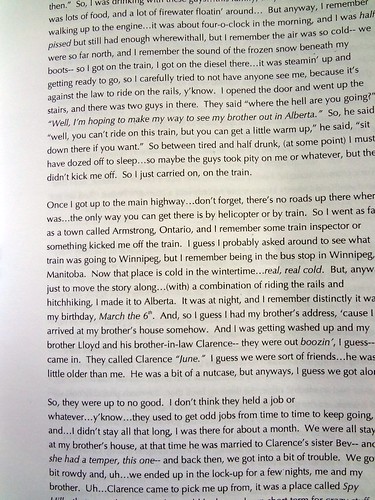
While I've had papers to write about this topic, art projects dealing with this line of research started out as diversions, but have ended up being an important part of the greater project. An interview with my father was transcribed and turned into a short zine, pictured above. I dedicated the last week to condensing the interview into fragments and using them in a stop-motion animated video (a still from it is included above as well), complete with a soundtrack featuring a rare Gordon Lightfoot song (!) and a book from the late 1800s.
I will post the video here once it's done. In the meantime, here is the link to the project blog.
http://newfoundlandstoriesofleaving.blogspot.com
Sunday, November 06, 2011
House Proud

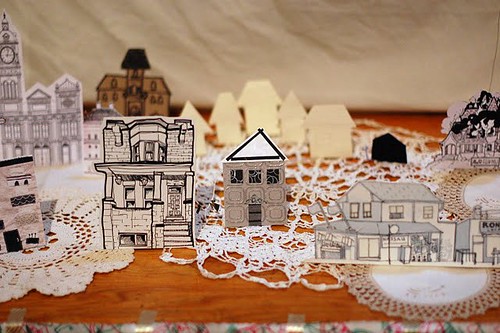
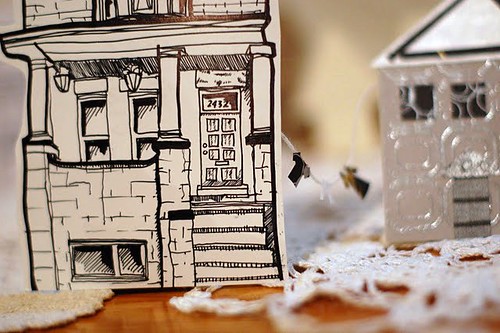
Here are a few photos that were taken a few weeks ago at Canzine 2011 of the City of Craft table, (or "City of Craft Village"), with houses by Ian Phillips, Jen Anisef, Kid Icarus, Cecelia Hayes, Roz Faustino, Reverend Aitor, Michelle Renaud, Becky Johnson, and myself. House number #2432 is my contribution-- a little ink drawing of my house in Baltimore. I've been looking forward to checking out pictures of this awesome little collaborative project co-ordinated by City of Craft wonder lady, Becky Johnson. There has been a ton of buzz about City of Craft as of late-- I am so sad to miss it for the first time this year since it started....be sure to check it out over the weekend of December 10-11, 2011.
Photos: Glowing Doll
glowingdoll.blogspot.com/2011/11/paper-city.html
www.cityofcraft.com
Thursday, November 03, 2011
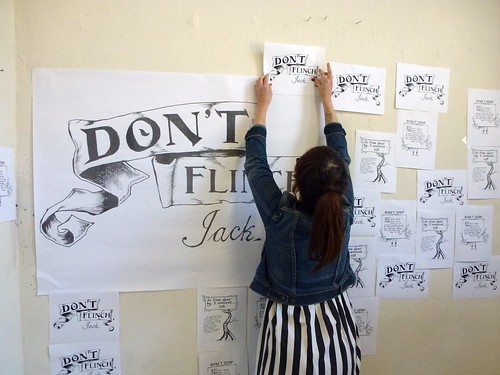
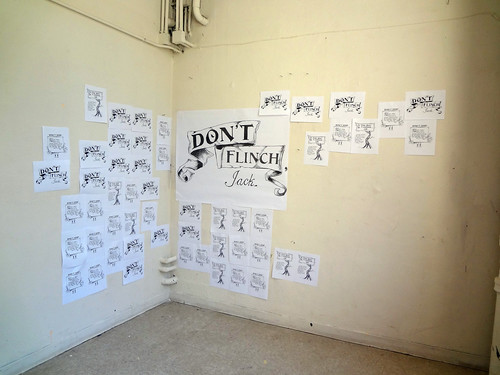
Don't Flinch, Jack.

Photos from an assignment from school that incorporates performance and hand-drawn posters of quotes about labour taken from Newfoundland "Jack Stories," Barbara Erhenreich's book, Nickled and Dimed, and an interview with my father. This performance isn't quite where I want it to be, so I won't post too much about it here. The photos turned out good, though!
Top Photo: Kristine Woods
Subscribe to:
Posts (Atom)