
 Here is a portion of a statement I am writing about the Temple dresses...
TEMPLE
The
Here is a portion of a statement I am writing about the Temple dresses...
The
 Call for Submission:


She Said Boom! Window Space is a street-level, in-store, 24-hour window gallery seeking art for bi-monthly exhibitions. We are looking for engaging, contemporary sculpture/installation, video/new media and two-dimentional work for consideration. To apply, email us a short proposal, an updated CV, bio and 3-5 jpgs of recent work. For more information, contact Tara Bursey at ssbwindowspace@hotmail.com.
She Said Boom! Window Space
372 College Street, Toronto.
ssbwindowspace@hotmail.com

SHOW HOURS
Thurs 11am-10:30pm
Fri 11am-10pm
Sat 10am-10pm
Sun 10am-7pm
ADMISSION
Adults $10
Seniors $6
Students $6
Children under 12 free
 The Shape of Things as they Are:
 Given the huge international response to her Shapetionary, a collaborative, artistic dictionary-type project, Maple Grove Ave. resident Margaret Flood seems to be creating a “World Within a Book” – or a world within her mailbox, at least.
The Shapetionary project began in September 2006, when Flood – intrigued by the idea of creating a shape-driven compendium of language – extracted 9,500 concrete nouns from her kitchen-shelf dictionary.
After advertising for participating illustrators on Internet artist message boards, Flood received responses from 900 artists worldwide, including ones from Belgium, Spain, Portugal, Tasmania, Indonesia, Austria, Turkey, Hungary, France, South Africa, Germany, Denmark, Sweden, Finland, Italy, Mexico, Russia and Jerusalem.
Having farmed out words for illustration at 6 to 12 per person, she has received roughly 2,000 drawings back so far, with newly interested artists forced to go on a waiting list.
Though she’s only steps from artsy Queen West, the Shapetionary project has opened Flood’s eyes – and connected her to – other flourishing artists’ conclaves far and wide.
“I had one email from Tasmania,” Flood says, “And then in a couple of weeks I got a lot, maybe 15 or 20 more. I’m realizing in a very concrete way that there’s a contemporary art scene in Tasmania, or Lisbon or Poland.”
While Flood was eager to accumulate drawings for the project, there were some she couldn’t accept: “When something was illustrated in a political manner – like a garbage pail with Toronto shoved in it – it’s kind of funny but not what I’m looking for.”
Certain requests Flood received were also curious.
“Some people asked for depressing words to illustrate, while others asked for ones starting with the same letter as their name, others for food, and some even for ones that nobody else wanted.”
Interestingly, Flood says that the Shapetionary project, which has a collaborative, dispersed nature rather unlike her previous sculptural installation works, was unintentionally driven by Toronto’s skyrocketing real estate market.
“I think this project is partly a response to a lack of affordable studio space,” Flood says, “It’s a byproduct of needing a project I could do in my home. I didn’t want to nail stuff to the walls [as would be necessary in painting, sculpture or installation] and freak out my landlord.”
“I love our neighbourhood,” says Flood, who grew up in Vancouver, has lived in Hamilton and Halifax, and moved to Toronto and Parkdale a year-and-a-half ago with her partner. “But to be an artist in this city is difficult.”
Like many Parkdale artists, Flood has a day job; luckily for her, it’s one that’s compatible with her other work.
“I’m a crisis worker with a mental health centre,” Flood explains, “I’m lucky to have a job I find interesting and fulfilling and that pays me decently. Not all artists have that.”
Overnight 12-hour shifts on the job also gained Flood some quiet time to move the project forward.
“At first I kept thinking, how can I get all the concrete nouns out of the dictionary without actually reading it? Can I do it by computer or something?”
Since she couldn’t find a way to do that, her dictionary reading took up about a month of time on the night shift, in the bath, in bed and on transit.
In the end, though, Flood says the time invested is worth it. Her dream for the project is to have a book published.
“It’s daunting to organize all the drawings by shape, but it would be really exciting,” Flood says. “And I’d love to have a big party for all who participated.”
While it’s doubtful that all of Flood’s Shapetionary contributors could make it to Maple Grove Ave. for the party, one thing’s for sure: those who did, no matter where they’re from, would probably feel right at home in Toronto.
Leah Sandals, March 2007 From Eye Weekly, March 1, 2007:
Prime Gallery's “Sex Pots II” group show may have some superficial strikes against it – it opened on Valentine's Day with a correspondingly gimmicky theme (craft and sex!) and a gratingly punny title – but the work is strong, and the intrinsic affiliations between the show's predominating ceramic medium and its, um, massage justify the theme. Ceramics having a palpable engagement with the body both in production (think Ghost, if you must) and when finished, as accessories, utensils and, of course, sex toys (though, despite the preponderance of phalluses here, there's nary a ceramic dildo to be found). Unsurprisingly, then, eating provides some of the most effective, entertaining forays: Robin Tieu has made an extra-priapic pestle to go with an unusually small mortar; Mimi Cabri has made Fauvist Love Cups; and Andrée Wejsmann, who contributes one of the show's non-ceramic pieces, has made cookie cutters in the shape of bunnies fucking. LE Gallery's Julie Moon trumps all, however, with a luscious, fun and utterly creepy sculpture that has nothing to do with cooking or dinnerware per se, but looks as if it might take a bite out of you: a floral patterned piece of porcelain in a blobby U-shape, with distended ends capped off by little, toothy, red-lipped mouths. Testicles dentatae, anyone?
“SEX POTS II” RUNS TO MARCH 24. WED-SAT 11AM-5PM. PRIME GALLERY, 52 MCCAUL. 416-593-5750. WWW.PRIMEGALLERY.CA.
 The following are shows on now in Toronto that I'm really excited about seeing...
 The Zine Scene: Small Press Means (Big) Business
Past decades may not have stood for low budget paperbacks masquerading as high art, but these days, small press publications are well known, widely read and an economically sound solution to starting a revolution - or simply getting one's voice heard.
"Zines are self-produced print publications, mostly photocopied and hand-assembled," said Tara Bursey, a volunteer collective member at the Toronto Zine Library. "Their roots lie in Dada publications of the early 1900s, science-fiction fan magazines of the '30s and Beat chapbooks of the '50s and '60s."
Zines were a large part of the punk rock movement in the '70s and '80s, gaining notoriety in the early-to-mid '90s as a part of the grunge/punk revival. These days, zines are a participatory cultural art form with a dedicated following and an unmatched reputation of inciting societal and institutional change.
Zine fairs, such as Canzine and Cut N' Paste Toronto, as well as the Brampton Indie Arts festival and various small press conventions across the country have opened up to the idea of these rough and ready creations as a valid literary art form.
"Some of my favourite zines from our collection are more art-focused," said Bursey. "[They] involve hand-touches such as silk-screened covers, sketchbook excerpts and reproductions of drawings."
Patrick Mooney, another collective member, relates to the somewhat radical roots in which zine subculture was first instated.
"Some of my favourite zines include Cometbus, America? and Doris," said Mooney.
Aaron Elliot, creator of Cometbus, is a lyricist, drummer, self-proclaimed poet and "punk anthropologist" who produces his seminal punk rock zine out of pure passion. Despite the Internet invasion and blogging overload, Elliot has created a name for himself through his and other hardcopy publications for which he has written - including Absolutely Zippo and Tales of Blarg.
Although print publications are slowly falling to the wayside in a world of electronic communication, Bursey suggests the sometimes-painstaking creativity involved with small print press is part of the appeal and authenticity, whereas virtually anyone can create a Web site. She lists her favourites in terms of true artistry rather than out-there ideals.
"A few that come to mind are zines by Michael Comeau - a Toronto printmaker, and a zine called Thumbprint Biographies by his wife, Tara Azzopardi," said Bursey. "Both contain drawn and silk-screened elements."
"We recently acquired a zine called Old Weird America, in which the author recounts things that happened to her in her hometown of Detroit. All the stories are rather dark, and involve the poverty and extreme social conditions that some parts of Michigan are known for."
The cost of making a bi-monthly zine of a couple hundred copies is approximately $100, give or take the corners one cuts; however, the expression of self is priceless and, as the Toronto Zine collective suggests, worth the effort it entails.
"I would say that the most important thing," said Mooney, "is to just do it."
The Toronto Zine Library is located at the Tranzac club in Toronto. If you happen to be in Toronto, the collective encourages volunteers to work throughout the weekdays or 1-3 p.m. on Sundays.
The Brock Press, February 6, 2007.
 I'll be showing two of my garlic works at Prime Gallery's annual (I think?) Valentine's event, Sex Pots II. The show will feature several pieces of erotic material-art works: fine ceramics, jewellry, glass and mixed media pieces will all be featured. It should be a fine show...if you can't make it out to the opening on the afternoon of the 17th, try to pop by Prime before the show ends in late March
| | ||

 Make A Zine!: A Workshop for Beginners
 A dear friend of mine- Morag Schonken- recently sent me a review she wrote of my From Russia With Love installation as a part of her mentorship program at MAWA. I've included it here in it's entirety...thanks for the ego boost, Morag!
A small brown package arrived in my mailbox. I flipped through the catalogue that I found inside: Anna, 22,
Fly Gallery is appropriately a store front window on
The use of medium to portray women seems to have a big impact on the way the viewer sees them. The photographs online objectify the women. They are objects to be acquired by men and for other women they can bring up a feeling of hostility. However when Bursey transforms them into pen and ink portraits they become real: they could be your best friend, your sister. Hostility is replaced with compassion and curiosity. In this way Bursey continues her “Ongoing investigation of repetition, and it's potential to depersonalize and desensitize within both institutions and domestic realms.” Again she succeeds in giving a personal identity back to these women.
 For Christmas, I recieved a hefty gift certificate from David Mirvish Books in Toronto, with which I purchased By Hand: The Use of Craft in Contemporary Art. It was a great find, and I would recommend it to anyone who works with or is interested in the use of craft-type techniques (knitting, sewing, bookbinding, hand-printing) within a fine art context. The book is beautifully designed, and features profiles and images of the work of international artists, both established (most notably Kiki Smith) and emerging. The books format- alloting 2-3 pages per artist- makes for a light yet addicting read...I read the entire book in one lazy afternoon.
 Here is a really neat project that I stumbled across a few weeks ago on an Instant Coffee mail-out. I am submitting some work for the Shaptionary, and Margaret needs as many helping hands as she can get. This undertaking is gigantic, so if you draw- even just a little bit- contact her and pitch in!
 Here are a few pictures of a project I have been working on involving the systematic fraying of an entire dress. I am almost done the first, and I will be moving on to a second one within the next few days...

Special to The Globe and Mail
Remember zines? The handmade, photocopied artifacts turned anyone with a particular interest or story to tell into a do-it-yourself publisher. A couple of young Torontonians are hoping people do recall zines fondly -- and not just as curios. They've collected more than 500 of them from the past decade or so and are housing the collection at the Tranzac Club, a somewhat dingy but warm clubhouse in the Annex.
The Toronto Zine Library is the brainchild of Suzanne Sutherland, 19, a University of
Last fall, Ms. Sutherland posted on a local online indie-rock message board, stillepost.ca, looking for volunteers to help with the project and donate zines. Patrick Mooney, a 26-year-old librarian at the CBC, jumped at the idea. "I'd gone to library school to be a librarian and had always wanted to do something like that," Mr. Mooney says, "so I was really excited when Suzanne posted about the possibility."
This past October, Ms. Sutherland, Mr. Mooney and about half a dozen other volunteers moved their Toronto Zine Library, which numbered about 300 titles, into the Tranzac. (Originally a club for expatriate Australians and New Zealanders, it's now a de facto cultural centre for the Annex.) Their collection, which includes everything from tiny, ragged hand-drawn comic books to slightly more professional-looking full-colour works, isn't much to look at on the surface (a ragtag bunch of stapled sheafs of paper housed in little linen racks), but is impressive in its depth and reach. There's a wide variety of zines from the past 10 years or so organized by genre: lit zines, fanzines, comic zines, political zines, zines about sex, cultural and social issues.
"Zines have been a vital part of publishing and subcultural history for a long time," says Tara Bursey, 24, an artist and freelance illustrator who has been involved in local zine culture for the past decade and recently came aboard to help out with the library. Ms. Bursey donated about 150 zines she had collected over the years to the library, bringing its total to around 500.
Ms. Sutherland estimates that 60 per cent of the zines in the collection are Canadian, with most of those being local titles, while Ms. Bursey's donation of punk and feminist zines has upped the American quotient.
Ms. Sutherland, Mr. Mooney and Ms. Bursey are all active zinesters themselves -- Ms. Sutherland makes little "novelettes" of her short stories; Mr. Mooney's are also literature-based, while Ms. Bursey worked on the feminist/punk fanzine Poseur Girl for eight years ("a lifetime in the zine world") and now puts out art-based zines. The three are the Toronto Zine Library's main staffers, keeping the collection in order and answering questions at the Tranzac on Sundays from 1 to 3 p.m. They're mildly critical of other zine-related initiatives in the city, like the Toronto Public Library's collection at the Toronto Reference Library: It's difficult to access and not well curated, Mr. Mooney says.
So far, their zine library has only had a few fans drop by (though the collection is accessible at the club throughout the week as well). Ms, Sutherland is hoping to spread the word and to hold workshops, particularly for youth, about zine culture and how to make zines.
But does anyone still care? At a time when the Internet has made self-publishing much easier than labouring over bits of paper and a photocopier, interest in making and reading zines has waned in recent years. Even the zine library crew admit that the scene isn't what it used to be. "There aren't even many places left where you can buy zines," Ms. Bursey points out.
During their local heyday in the early 1990s, they were carried by retailers such as the now-defunct Tower Records, but today only a few independent bookstores and music shops offer a handful of titles. While most of the Toronto Zine Library's zines come from donations solicited online, from friends or gathered at zine fairs, Mr. Mooney also continues to buy a few new titles to add to the collection.
Lindsay Gibb, editor of Toronto-based Broken Pencil, a magazine devoted to zine culture, says zines may have gone down since their heyday, but that doesn't mean people aren't still busy cutting and pasting. "There is still more that one can do aesthetically with a zine than they can with a blog," she says. "Blogs don't have the same feeling as zines, so people continue to make zines for some of the same reasons that print magazines aren't switching over to the Web. Some people like to have a physical product to show for their efforts."
And, Ms. Bursey says, "the best thing about zines is that [they're] completely democratic. Anyone can make one, and they're cheap to make and distribute. The scene has sort of petered out, but it's definitely something worth preserving."
"The reason why people make zines doesn't change -- people are always going to feel the need to express themselves by creating something on their own," Ms. Sutherland adds. "I don't think that's an impulse that disappears, whether it's the nineties or 2030. And just as you don't have to be into alternative culture to enjoy comics, it's the same with zines. There's something for everyone."
 I'm proud to be participating in Bobby Five's annual Holiday Auction and Exhibition this year. All proceeds from the reception/auction will go to families in need via Parkdale Community Health Centre. Please come out on December 10th to show your support, and bid on amazing work by some of the artists/fine illustrators who have shown at Bobby Five!
Charity Auction and Exhibition
Bobby Five Gallery
Sunday December 10, 2006 from 6pm-9pm
All donations made generously by the artists that have shown at Bobby Five Gallery in the past two years.
The
We are inviting anyone and everyone to come participate in the auction, meet the artists and support the local community efforts on Sunday December 10th from 6-9pm. We will conduct the auction silently, as well as provide a donation box and all proceeds from the bar will be included in our grand total donation to the community center.
We look forward to seeing you there!
Pictured: Tara Bursey, Garlic Pasties-detail (2006)


 I've been to five or six fantastic art shows within the past week or so. Here are some recommendations based on this week's rounds...do be sure to check them all out if you get the chance...
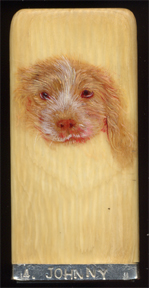
Dark human acts directed at four legged things. In her latest body of work, Holst looks into the cracks of human socialization, those hiding rage and boredom, greed and egocentricity.
July 13, 2006-January 7, 2007.
Organized by the Textile Museum of Canada and the Koffler Gallery, this major group show features work in a range of media, from sculpture to photography, by nineteen contemporary artists from
Hand-Face-Body- Louise Lemieux Bérubé, Gontran Brennan, Ginger Brooks Takahashi, Kate Busby, Washboard Collective, Ying Gao, Sonia Haberstich, Filiz Klassen, Elana Kochman, Melissa Levin, John Krynick, Teresa Marcy, Hazel Meyer, Dorie Millerson, Allyson Mitchell, Janet Morton, Gordana Olujic Dosic, Vessna Perunovich, Christa Rowley, Lois Schklar, Auriane Sokoloski, Barbara Todd, Andrea Vander Kooij, Joy Walker, Ute Wolff
Gladstone Hotel,
October 13-November 26, 2006.
Playing with the double meanings that "hand", "face" and "body" have in the context of textiles, curators Chris Mitchell and Helena Frei have assembled a diverse group of works whose makers range from established artists with impressive track records to students in the process of refining their focus.
With the intimate, personal overtones of textile, the act of using it as a medium suggests human presence. The participating artists speak of things as disparate as biblical lyrics, cancer and the fate of dryer lint. Whatever the subject, whether addressing issues of body image, sexual preference, intimacy or pornography, the work speaks of the body either explicitly or by inference.
Unholy Alliance: Art+Fashion Meet Again Nick Cave, Lydia K, Clemencia Labin, Kent Monkman, Matthew Vescovo and Viktor & Rolf
Museum of Contemporary Canadian Art, 952 Queen Street West, Toronto. (416)935-3087
October 5-November 12, 2006.
Sponsored by PUMA Canada and MAC Cosmetics.
Unholy Alliance is part of the Alphabet City Festival 2006: TRASH.
Pictured: Dana Holst, Johnny, 2006.
www.katharinemulherin.com
www.textilemuseum.ca
www.gladstonehotel.com
www.mocca.toronto.on.ca


