Monday, February 20, 2012

Amy Borkwood Interview on TCA

dscf2637

Amy was my subletter while I was in Baltimore!  She is also an accomplished bookbinder, longtime zine maker and all-round awesome person.  I interviewed her recently for Toronto Craft Alert-- in it she talks about how she has integrated zines into her job as a community worker.  Mega inspiring stuff.

http://torontocraftalert.ca/2012/02/16/questions-for-crafters-amy-borkwood/

Saturday, February 11, 2012

Zine News

Latest Zine

1. My latest zines, the first issue of Goin' Down The Road: Newfoundland Stories of Leaving and Museozine are now up for sale in my Etsy Shop for anyone who's interested in picking up a copy by snail mail.

2. On the flip side, locals can now pick up copies of either zine at local art shop No Show Exhibits, which is a part of Katharine Mulherin's Queen West art empire of amazingness.  The shop can be found at 1082 Queen Street West, just east of Dovercourt.

3. Said zines will be traveling all the way to Halifax, where they will be both exhibited and for sale in Eyelevel Gallery's Reshelving Initiative 5 exhibition.  You can learn all about it here.

4. Finally, there is no confirmation on this yet, but I'm hoping to table OCAD's very own zine fair, happening at the end of the month. Once I know that I have a table reserved, I will post more specific info about this as soon as I can.

Friday, February 10, 2012

First Art Purchase

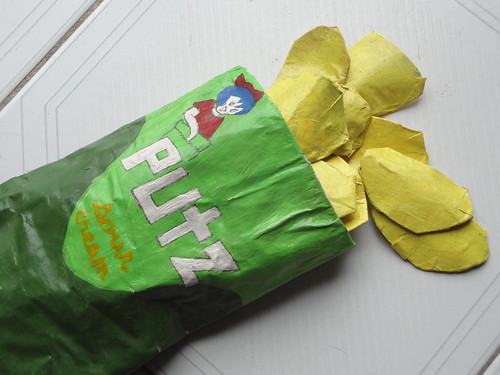
Putz

I am unbelievably excited to announce that I've made my first major art purchase! It's a 'Putz' bag of chips sculpture by the artist STO, inspired by the regional chip brand Utz from Pennsylvania. Utz chips were a staple in Baltimore-- they were everywhere there, and we ate a boatload of them. So this is a super cool joint Valentine's gift for us, financed mainly with my own art sales at Katherine Mulherin's new-ish Queen West art shop, No Show Exhibits.

The chip bag was originally included in a New York exhibition called My Slow Called Life in NYC at Mulherin Pollard Gallery. For the show, STO recreated his entire apartment in paper mache. Photographs of the installation can be found here on STO's blog.

  Putz

Here is Ben wishing these were a real life bag of Utz' Crab flavoured chips, a Baltimore favourite of ours...either that or Carolina-Style BBQ...

Friday, February 03, 2012

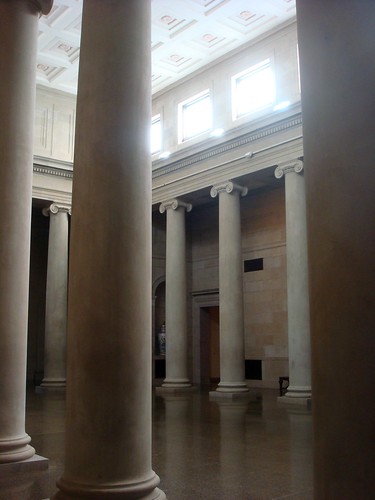
Columns and Swoops

Fox Court Museum of the American Indian Walters Art Museum

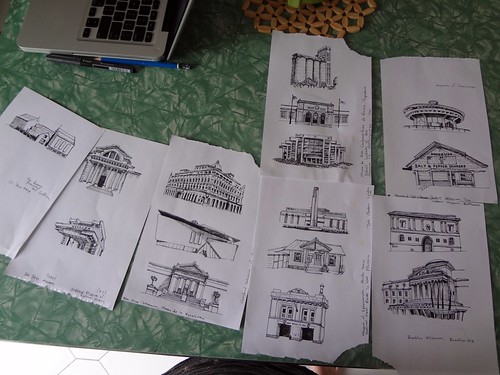
Somewhere along the line-- during my time in the States, most likely-- I turned into an architecture gawker. In the States, I went to museums and felt that I could admire the architecture without having my enjoyment of it be tainted by a certain degree of bitterness about the politics and astounding prices that are par for the course among (many, but not all) Toronto institutions.

Looking at these photos, it dawned on me how cool it would be to make a big series of pictures like this. I'm hoping to make it out to the DIA in Detroit later this month, so we'll see if I can add a new photo to the pile that soon.

Fox Court, Baltimore Museum of Art, Baltimore, MD
Looking up at the Museum of the American Indian, Washington, DC
Central Court, The Walters, Baltimore, MD

Tuesday, January 31, 2012

Charles Ledray

Charles Ledray Charles Ledray

Charles Ledray is a Seattle-born artist I became interested in while working at the Textile Museum last summer.  I've been bogged down with school stuff for the past week and haven't posted anything in a while, so here is a little piece I wrote for an assignment about the work pictured above entitled workworkworkworkwork, first exhibited in 1991.  FYI: I will be building a "fantasy exhibition" of sorts around this work for a curating class.

*
Charles Ledray
workworkworkworkwork, 1991
588 objects: Fabric, thread, cotton batting, yarn, embroidery floss, nylon cord, carpet, leather, wood, metal, foil, metal chain, wire, nails, porcelain, pumice, beads, buttons, cardboard, corrugated cardboard, paper, magic marker, paint
Approximately 13.7 m x 25.4 cm x 5 cm
Private Collection, Houston, TX

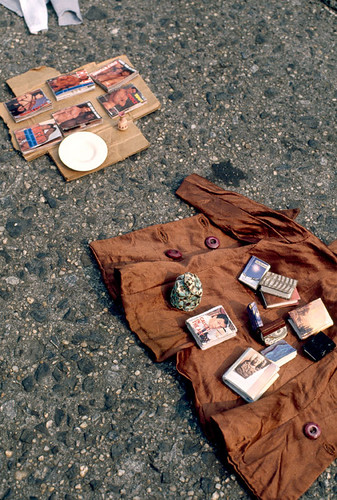
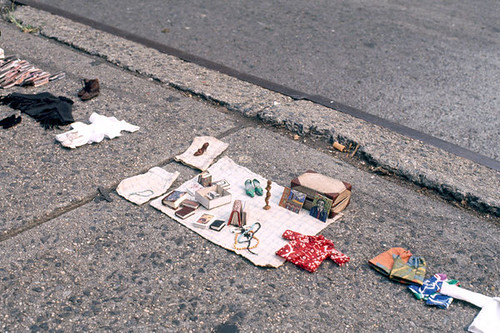
Charles Ledray is an artist working primarily in the area of fibre-base sculpture and installation.  His work is characterized by labour-intensive and somewhat obsessive tendencies towards hand making.  A compelling blend of high-art and craft, his best-known works are installations comprised of handmade men’s suits, hats, fantastical garments and ceramic vessels that play with multiplicity and scale.  In his installation workworkworkworkwork (1991), 588 miniature objects-- among them garments, magazines, housewares and multiple pieces of art-- were displayed in New York’s Astor Place in the form of an impromptu street sale.  Each of the objects was painstakingly hand-crafted by Ledray, and their presentation on a busy sidewalk-- often splayed across shrunken replicas of flattened cardboard boxes and rumpled raincoats-- cleverly blurred the lines between art and mass-produced object.  The individual objects themselves are an enigmatic combination of abjection and whimsy, like a half-inch dildo in a dollhouse.

Both the presentation and objects of workworkworkworkwork evoke a number of responses in the viewer.  The lack of human presence in the installation causes the objects to convey a sense of melancholy and loneliness, imploring one to piece together biographical details of the hypothetical owners of each cluster of tiny belongings for sale. The objects are reminiscent of toys or props-- accessories for a Ken doll whose dream house was foreclosed and who is drifting from fleabag hotel to fleabag hotel.  Each object straddles the line between precious and imprecious, with grasshopper-sized hardcover novels standing spine up as if tossed aside among real cigarette butts on the sidewalk.  The centrality of labour is evident in the work, from Ledray’s labour to the title of the work to the work of people who labour to make mass-produced objects in sweatshops that move from multi-national chain store to church sale to sidewalk vendor to landfill.  Finally, the piece’s presentation on a public sidewalk is dependent on the presence of the pedestrian to complete the work.  This brings to mind how members of dominant society-- in the case of workworkworkworkwork, the Manhattan white-collar worker, socialite, window shopper, or tourist-- view people on the margins of society.  The homeless, street vendors and people performing menial jobs are relegated as background players against an urban backdrop, always viewed peripherally.  The miniaturization of the objects in workworkworkworkwork poignantly reflects this.

While it is easy to get completely caught up in the sense of wonder and delightful seediness of Ledray’s tiny sculptural stand-ins, a key to the work’s success lies in its presentation in public, on a sidewalk in a huge metropolis that dwarfs everything it contains. Situated in Manhattan-- an iconic American city which has long been seen as a centre of commerce, immigration, power and consumption-- workworkworkworkwork interacts with its site’s impressive web of history, from deadly industrial disasters in garment factories and riots fuelled by class resentment to the economic and social conditions of New York City in 1991 when workworkworkworkwork was first exhibited.  The relationship between the objects-- which despite their scale evoke personal histories that feel very real-- and the site activate something much larger than the diminutive objects laboured over by Ledray: a greater social history of a city that lies deeper than a sidelong glance during a brisk walk across a crowded intersection.

Photos courtesy of the Whitney's website: http://whitney.org/Exhibitions/CharlesLeDray/Images
Tuesday, January 10, 2012

Museozine

Museozine

I completed my latest zine exactly a week ago, making my collective zine output total a whopping four zines-- two were collaborations, and two were my own-- in 2011, the official year of the Revenge of Print.  Looking back, I feel that I did well...I did my part for the revenge!  Print was one of my first loves. Needless to say, I hope it is here to stay.

While this zine came to fruition mere days into 2012, I consider it a '2011' zine because so much of its research and construction was done in 2011.  In a nutshell, Museozine is a zine of interviews with friends of mine-- all wonderfully creative young people who craft, make music and make art on their own terms-- about their museum experiences.  These interviews started off as casual research I was doing for my job at a small Toronto museum last summer.  The interviews were, in some cases, so honest and joyful and surprising that I felt like I just had to publish them in zine form as a way of honoring and preserving them.

Some of my favourite moments in the zine include the following quotes:

"When I was a young kid I loved to sit upside down on the couch (legs up the wall, head hanging down over the end of the seat) and look at the living room/kitchen upside down and fantasize about how cool it would be to be able to walk around in a house that was upside down.  Really upside down, but defying gravity so everything would stay in its place, and to walk in the front door and try to navigate around the house that way and see all the familiar objects in this whole new way.  I did this a lot.  It was a bit of an obsession.  There's my dream museum-- my childhood home upside down."  --Elaine B.

"If I could create my own museum it would be quite a bit like my own apartment, except much, much bigger...everything from old print (magazines, comic books, fanzines, old books) to old toys, various pop culture items, guitars and music gear, and-- probably most importantly-- vinyl records."  --Matt H.

"I think a hobo museum would be cool.  It would have a riding the rails simulator, and a hobo camp staffed with historical re-enactors like Black Creek Pioneer Village, and maybe a folk singer from the 20s or 30s.  Although this is changing, museums tend not to represent the lives of people on the margins of history."  --Patrick M.

Today, headlines about millions of dollars in funding for culture and research being cut from both the municipal and the provincial budget over the next year were splashed across Toronto papers.  Sad when you consider how much museums have captured the imaginations of the people I interviewed.  Most of these interviews referred to childhood museum experiences, which, for the case of many, happened in the 1980s, before the massive culture funding slashes and economic recession of the very late 1980s and early 1990s.  There is currently an accessibility problem among Toronto's museums.  I hate to think that the current economic climate and recent cuts will make the current problem (or crisis, even) of local museum accessibility--and not to mention cultural funding-- even worse.

For lots of impassioned writing on the topic of public access to museums and cultural institutions, check out Toronto critic and arts writer Leah Sandals' always engaging blog, Unedit My Heart.

Monday, January 09, 2012

Danville Community Encyclopedia

encyc_cover

A few days ago, I finished my latest zine, Museozine.  This got me thinking about how artists have used the interview format in both performance and printed matter.  Tonight in my Publications class I was introduced to a really awesome example of this (somewhat minor) tradition called the Danville Community Encyclopedia by artist Anna Callahan.  For this project, Callahan hung out in a public library in Danville, Illinois interviewing members of the public of all ages about their respective areas of expertise.  She eventually filled an entire book with transcriptions of the interviews she collected-- the encyclopedia entries as diverse as Ghostbusters, Gospel Songs, Attention Deficit Disorder, Protest, Chicago Illinois, Canada and Tupac.

This was an uber-limited edition.  I wish I could buy this!

For more on Anna Callahan and her community projects, check out her website.

(P.S: This is my 300th post!)

Monday, January 02, 2012

16 Museums

24 Hours Later

For a zine that I'm working on which should be done later on today, hopefully!  More on this later...

Sunday, December 18, 2011

Crime Map Walk

Crime Map Walk Crime Map Walk Crime Map Walk

Here are some photos from my final project for my Performance Art class.  The following text is my short artist statement about the project.

Crime Map Walk
Performance documentation from 10.12.11 
Video, laptop, paper, pins


This performance is inspired by the idea of the artist as traveler, responding to the city they find themselves in as well as walking tours and maps.  Its jumping off point was an online “crime map” of Baltimore, which one can consult to find an up-to-the-minute map and information indicating the locations and types of crimes committed across the city.  Before coming to Baltimore, I found myself browsing such maps as a way of attempting to distinguish between the “good” and “bad” parts of the city.  As any long-time resident of Baltimore knows, it is quite difficult to make such a distinction here, where there is a fairly high crime rate city-wide.


For this performance, I used the Baltimore Crime Map (http://crimebaltimore.com/) to trace a walking path between my house in Charles Village and a main intersection in the Inner Harbour.  I then walked this long path, trying to pass as many sites of recent crimes as possible, taking photo-documentation in the form of over 100 photographs taken every half-block or so along the way.  These photographs were then turned into a stop-motion style video, which serves as the main document of the performance.


This performance plays with the idea of how people respond to crime and fear in an urban environment.  As a defense mechanism, many people avoid areas they feel are “bad” in their day-to-day travels.  This performance reverses this logic, and in doing so, faces certain fears of crime head on.  Also, in performing this walk on a Saturday during the holiday season, I realized that hardly anyone was walking around on the streets I walked during my journey.  This performance also attempts to address the importance of street life and pedestrianism in keeping cities both lively and safe.  

Tuesday, December 13, 2011

That's All Folks!

That's All Folks!
That's All Folks!
That's All Folks!

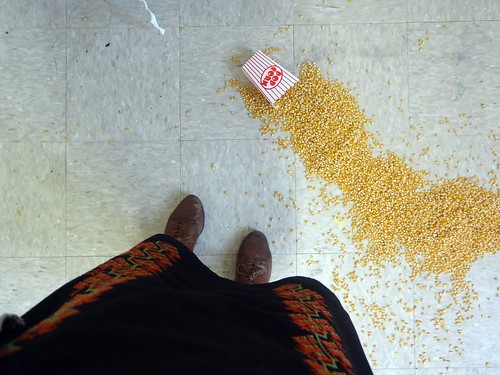
Installation with popcorn kernels, uniform and props, completed last week.  I've never put popcorn kernels on a wall before...now I know it's possible!

I think this piece is a distillation of a lot of the feelings I've had and things I've seen while visiting the States.  Most of all, I think it is about how history moves from one period of time to the next, and about the feeling that things are about to change.  It is also about the loss of illusions.

One of my favourite movies of all time is The Last Picture Show, which I couldn't help but think of as I was thinking up this piece, as well as thinking up the performance I did in McKeldin Square a few months ago.  While the film's trailer focuses a little more on the torrid affairs between the residents of the fictitious town, Anarene Texas, the movie is set during a time when the movie theatre was beginning to play less of a role in people's lives because of the home television set.


Also on the topic of the movement from one historical period to the next, I read the following quote in a class recently, written by the American art critic Martha Schwender on the use of appropriation in the work of the artist Sherrie Levine.  It excited me because it questions whether or not we are nearing the end of a long period of overarching irony/cynicism in contemporary art...or perhaps also a period plagued by a sense of cynicism in general?

Appropriation rose out of this desire to have it both ways, to keep what you loved-- or at least knew intimately-- and still make art. It was a great solution.  But I was born in the 1970s, following the burnout of the 60s, and it has run aground in recent years. Not only have artists like (Sherrie) Levine, Jeff Koons and Richard Prince been dragged through the legal system for their cultural borrowing, but the postmodern irony and cynicism on which Appropriation was founded also feels outmoded in the Occupy Age.

Friday, December 02, 2011

Adventures in Canada

First try at making a movie! I'm happy with it. Mr. Lightfoot-- if you're reading this, please don't sue me for copyright. Technically this is student work. I am a big fan of yours, and I'd be really upset if you were mad at me...!

Monday, November 28, 2011

Adventures in Canada

Latest Zine

Latest Zine

Adventures in Canada

Busy, busy, busy these days finishing up my semester at school (and my time in Baltimore City!), so there has been little time to write here.  One of my major projects right now is a body of work inspired by the story of my father leaving Newfoundland and traveling across Canada before finally settling in Toronto in 1973. It's a wild story that can serve as a snapshot of so many things which relate to Canada's recent history-- the migration of Maritimers to large Canadian cities to look for work in the mid-20th century, Toronto as Canada's "boomtown" in the 1970s, and a look at how working people have been affected by the steady decline of industry.

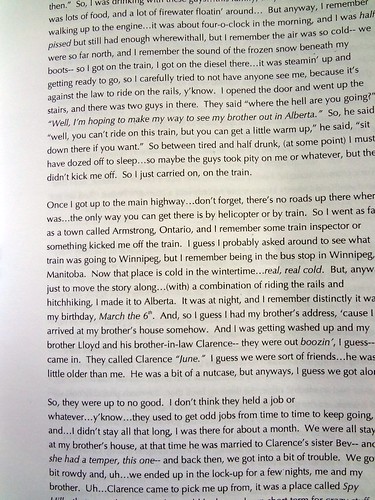
While I've had papers to write about this topic, art projects dealing with this line of research started out as diversions, but have ended up being an important part of the greater project.  An interview with my father was transcribed and turned into a short zine, pictured above.  I dedicated the last week to condensing the interview into fragments and using them in a stop-motion animated video (a still from it is included above as well), complete with a soundtrack featuring a rare Gordon Lightfoot song (!) and a book from the late 1800s.

I will post the video here once it's done.  In the meantime, here is the link to the project blog.

http://newfoundlandstoriesofleaving.blogspot.com

Sunday, November 06, 2011

House Proud

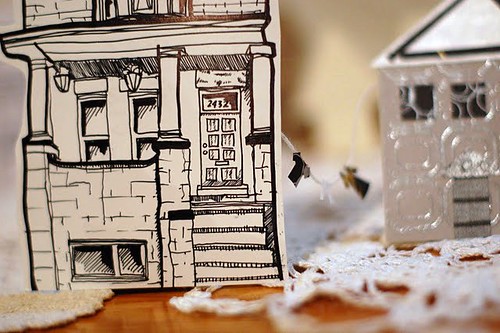
Paper City Paper City

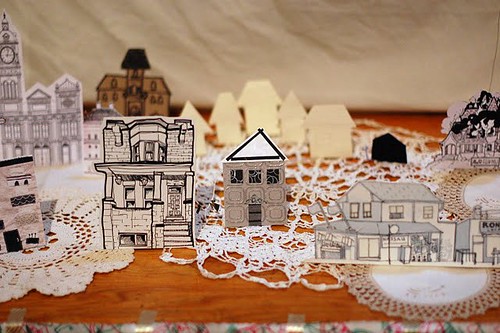
Here are a few photos that were taken a few weeks ago at Canzine 2011 of the City of Craft table,  (or "City of Craft Village"), with houses by Ian Phillips, Jen Anisef, Kid Icarus, Cecelia Hayes, Roz Faustino, Reverend Aitor, Michelle Renaud, Becky Johnson, and myself. House number #2432 is my contribution-- a little ink drawing of my house in Baltimore.  I've been looking forward to checking out pictures of this awesome little collaborative project co-ordinated by City of Craft wonder lady, Becky Johnson. There has been a ton of buzz about City of Craft as of late-- I am so sad to miss it for the first time this year since it started....be sure to check it out over the weekend of December 10-11, 2011. 

Photos: Glowing Doll
glowingdoll.blogspot.com/2011/11/paper-city.html

www.cityofcraft.com

Thursday, November 03, 2011

Don't Flinch, Jack.

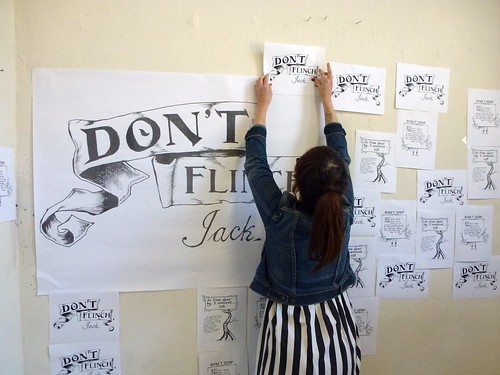
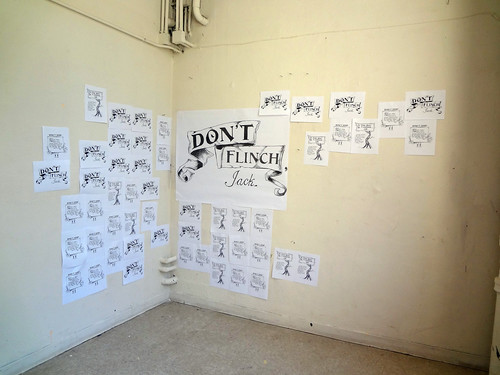
Don't Flinch, Jack. Don't Flinch, Jack.
Photos from an assignment from school that incorporates performance and hand-drawn posters of quotes about labour taken from Newfoundland "Jack Stories," Barbara Erhenreich's book, Nickled and Dimed, and an interview with my father. This performance isn't quite where I want it to be, so I won't post too much about it here. The photos turned out good, though!

Top Photo: Kristine Woods

Wednesday, October 19, 2011

The Wall at the Back of the Theater

The Brick Wall at the Back of the Theatre

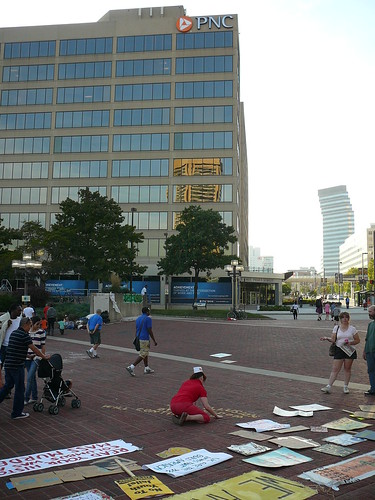
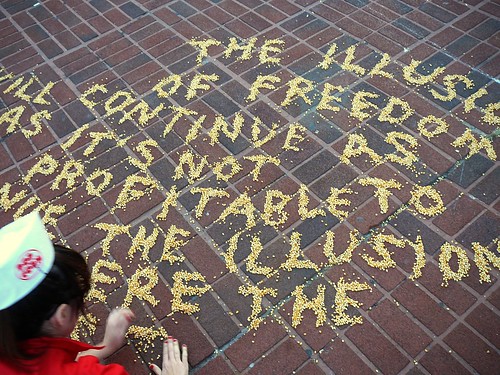
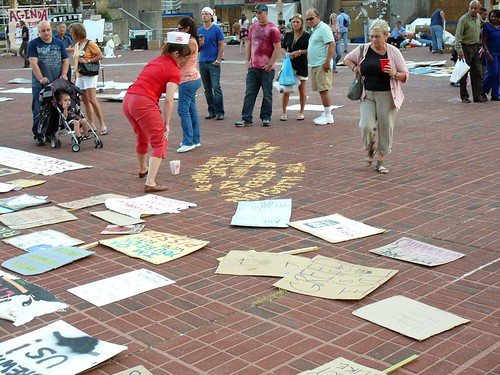
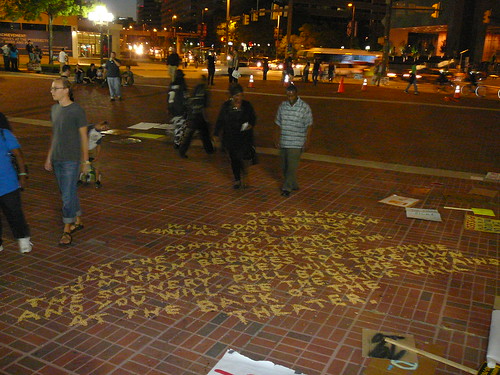
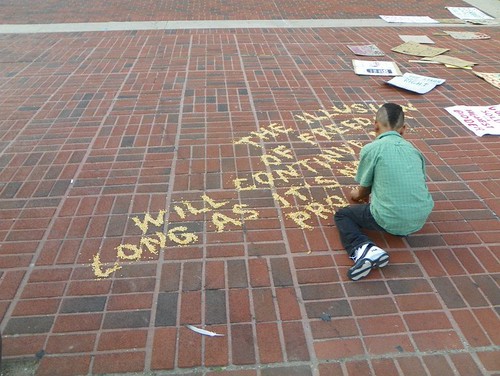
A couple of Sundays ago, I decided to do a performance for Occupy Baltimore-- Baltimore's version of the Wall Street Protests-- which started a few weeks ago in a public square in the Inner Harbour area of town. The performance was inspired by a project I was assigned in a performance class (I still have yet to do the actual assignment in class on Monday...this wasn't the school assignment) where we were asked to develop a character or alter ego.  For this piece in McKeldin Square, I became an out-of-work "popcorn lady" who lost her job because the theatre she worked at (In the present? In the 40s or 50s?  I'm not quite sure...) closed down.  The performance consisted of me kneeling on the ground for two hours, spelling out a long quote in popcorn kernels.  The quote belongs to the annoying, but highly quotable (Baltimore-born) Frank Zappa, who once said: "The Illusion of freedom will continue as long as it's profitable to continue the illusion.  At the point where the illusion becomes to expensive to maintain, they will take down the scenery...pull back the curtains...and you will see the brick wall at the back of the theatre."  The quote was slightly abridged from it's original form for the performance, for the sake of my knees and back.

The Brick Wall at the Back of the Theatre

This performance was obviously inspired by my time in Baltimore-- and the United States.  It is a crazy time to be here-- there have been protests across the country, and Baltimore itself has been a troubled city since the 1960s.  The downtown core of Baltimore is beautiful, but largely deserted.  There is poverty and blight everywhere.  While the arts community and a select few are fighting hard for the city to have a chance at a renaissance, it will be a long, hard road.  What are the odds that it will happen?  This is a city made for a million people, and the population has steadily declined since the 1970s to 620,000 people.  Poor Baltimore-- in so many ways, the city and its people have been really inspiring, but I leave for good in December.  I know it will haunt me, and I will wonder and worry about it as if it was a wayward friend.

The Brick Wall at the Back of the Theatre

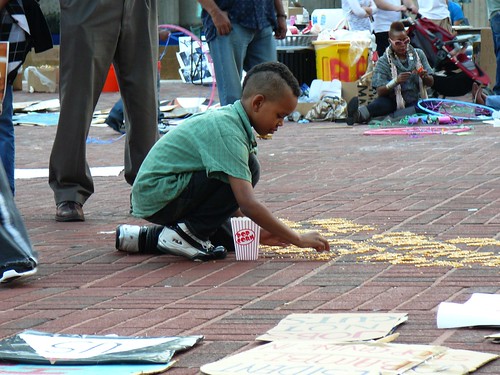
On a lighter note, executing this piece was rough.  I did a somewhat similar performance with popcorn kernels last spring that took just under half as long, and that was hard enough.  Because the piece is at least partially about labour, the endurance aspect of the piece was fitting.  About a third of the way through the quote, this sweet little man offered me a bit of help.  He did one letter-- an F-- before I shoo-ed him away because he was slowing me down.  The poor guy was very disappointed, and reluctantly left me to my work after a while.  I really hit my stride after he left.

The Brick Wall at the Back of the Theatre

This was the first piece of "work" that has materialized since my arrival here, and I'm glad to have it more or less behind me. There is definitely more to come soon.  I'll end this post with the lyrics of a Randy Newman song I only just heard for the first time yesterday.  While my photos don't really illustrate the Baltimore this song speaks of, the idea of it is definitely simmering close the core of this piece.

Beat up little seagull
On a marble stair
Tryin' to find the ocean
Lookin' everywhere

Hard times in the city
In a hard town by the sea
Ain't nowhere to run to
There ain't nothin' here for free

Hooker on the corner
Waitin' for a train
Drunk lyin' on the sidewalk
Sleepin' in the rain

And they hide their faces
And they hide their eyes
'Cause the city's dyin'
And they don't know why

Oh Baltimore
Man it's hard just to live
Oh, Baltimore
Man, it's hard just to life, just to live

The Brick Wall at the Back of the Theatre

Monday, October 10, 2011

The Illusion of Freedom...

The Illusion of Freedom...

My little helper at work in McKeldin Square, at Occupy Baltimore yesterday afternoon.  Much more on this later.

Photo: Jacob Ryan Smith via Facebook

Friday, October 07, 2011

NFLD Stories of Leaving


Started a new blog yesterday afternoon for a school project, and it is likely that the project will become an ongoing one. The project will probably apply to very few reading this, but if you can think of anyone who would be interested, please feel free to pass on the blog address/call for submissions.

http://nfldstoriesofleaving.blogspot.com

FYI: Goin' Down the Road is a classic Canadian film about two Maritimers traveling to Toronto look for work in the early 70s. It provided much inspiration for this project.

Thursday, October 06, 2011

Das Bande

Das Bande

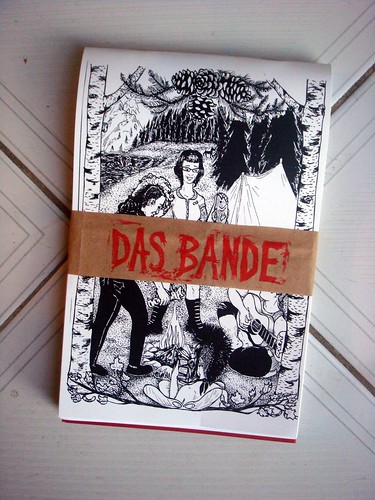
Among all of the work and relocation-related craziness I was faced with this summer, I somehow managed to begin one zine collaboration project, and end another. This one-- Das Bande-- was a whopping year-and-a-half in the works. I am happy to say that it finally made its way into the world in August...the week that I left town!

  Das Bande

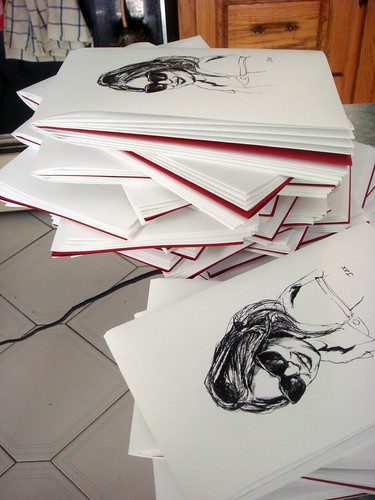
Das Bande was a collaboration between Gena Meldazy and myself. Gena was one of the people interviewed for my Punk Rockers on Creative Survival and the Survival of Creativity zine in 2009. Shortly after finishing that project, Gena asked if I would like to work with her on a zine project that focusses on women involved in punk rock across Canada. The zine ended up featuring several interviews (mostly conducted by Gena) with individuals (most impressively Jade Blade from the legendary Vancouver punk band The Dishrags...whoa!), and the interviews were broken up by drawings I did of girls from in and around Toronto's punk scene. For the cover, we asked the formerly of Toronto/now of Vancouver printmaker and illustrator Megan Speers to draw something, and the result-- a gang of girls camping in rural BC, presumably?-- was totally and utterly amazing. After much humming and hawing over an appropriate name for the zine, we finally settled on Das Bande, and I hand stamped title bands for the small print run of 50 zines in total. The zine also has a fold-out poster of the interior drawings I did for the zine, which I unfortunately lacked the foresight to photograph...darn!

Do you want a copy of this zine?  Gena is overseeing its distribution, and I suspect that they may be all accounted for seeing as the print run was so small.  If you're interested, contact Gena and ask her if and how you can get one.


Monday, September 26, 2011

Robyn Love Interview on TCA


Conducted an interview with knit-ty multi-disciplinary artist Robyn Love last week in honour of the massive public art project that she was commissioned to do for the Cheongju International Craft Biennale. The interview was posted on TCA last Friday...read it and get inspired! http://torontocraftalert.ca/2011/09/23/questions-for-crafters-cheongju-robyn-love/

Image: Water Tower Cozy by Robyn Love, courtesy of her website.

Tuesday, September 20, 2011

Cover Stories

Cover Stories Cover Stories


Before I left to come to Baltimore exactly one month ago, I packed my life with an unbelievable amount of projects-- mostly collaborative.  Some had been in the works for a while, and I felt a real responsibility to have things finally materialize before I left town.  It was also a good way to spend some time with the people I know before I left Toronto for a while.

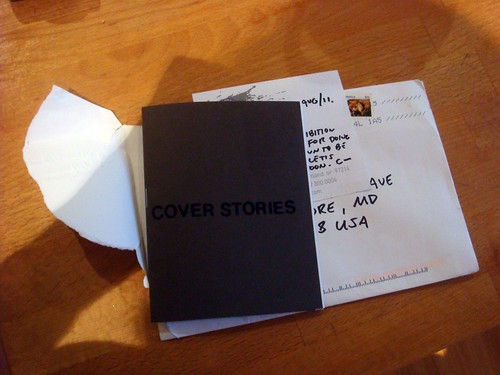
One such project was "curating" the exhibition Cover Stories for the Toronto Zine Library.  While I was asked by the TZL to curate an exhibition, it was largely a collaboration between myself and three of the members of the TZL Collective-- Lyndall, a talented lady who made a documentary about Who's Emma a few years ago; Chris, the creator of many zines over the last 10 or 15 years, at least one of which is considered a Canadian "classic"; and Patrick, who is one of the founding members of the TZL, and is a great all-round guy and an amazing baker.  After being asked to help create an exhibition, I spent three or four weeks going through the library's massive collection with a fine tooth comb, picking out any zines that I liked especially, or pulling out zines that shared some sort of mutual connection.  While I went into this project not having any curatorial theme in mind whatsoever, one slowly emerged. As an artist and zine-maker, I couldn't help be attracted to interesting and unique design in the zines I came across.  I eventually decided that creating a narrative about zines through their covers might be a neat way to create an exhibition that, while forming physical zine "groups," doesn't claim to draw on any real fixed history of zine-making.

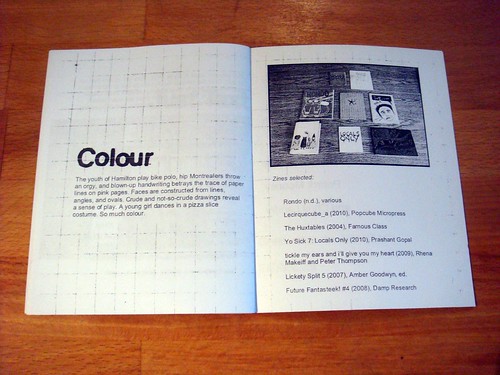
I eventually chose a pile of zines and divided them into 6 loose thematic groups which eventually became "Just Text," "Print Media," Colour," "Little Zines," "Hearts and Other Body Parts," and "In the Mail."  Each collective member of those mentioned above chose two groups at random to write short didactic descriptions about to serve as wall text for the exhibition, interpreting the themes as they saw fit.  I wrote the following summary of the exhibition:

Cover Stories is an exhibition of selections from the public collection of the Toronto Zine Library.  Using thematically-grouped zine covers as a springboard, we thought it would be interesting to highlight zine art and design as a way of telling the greater story of zines– what they are, how they’ve changed over the years, and why they continue to be a valuable and relevant medium.  While some selections from the library have been refashioned as photographs for this exhibition, others appear in their original form to be handled and appreciated as intimate and tactile objects.   In creating this interactive exhibition, we hope that you will spend time with some of the titles on display while learning about zines as both an art form and a method of communication.


We were REALLY down to the wire with finishing work for this exhibition-- we ended up installing the show two days before I left for Baltimore!  I am thrilled with how the exhibition turned out-- it was a really great collaboration, and everyone played a really important part in making it happen.  Lyndall took some really fantastic pictures of the zines that were chosen for the exhibition, and Chris played a huge part in designing and assembling what ended up being a really wonderful exhibition zine/catalogue (pictured above), which will serve as a great document for after the show comes down.

Cover Stories should still be up in the Southern Cross Room of the TRANZAC Club at 292 Brunswick Avenue, in the Annex.  I'm not sure when it's coming down, but if you're interested in checking it out, do so soon!