Showing posts with label photography. Show all posts

Sunday, December 22, 2013

Meryl McMaster: In-Between Worlds at the AGH Design Annex


Meryl McMaster, Wingeds Calling, 2012, digital chromogenic print. Courtesy of Katzman Contemporary

While things have been a little quiet on this blog as of late, I've been working away behind the scenes on two exhibitions that both open on February the first.  The bulk of the preparations have been for an exhibition at Pier 8 in Hamilton called Winterlore, a series of outdoor installations that draw from international folk symbols and stories that will animate the pier during Hamilton Winterfest's all ages kick-off event.  More to come here on that exhibition shortly.

A satellite exhibition of the incredible work of emerging photographer Meryl McMaster will, as part of Winterlore, be showing concurrently at the AGH Design Annex.  This show will give the Pier show a presence on James Street North during and after the kick-off event.  Meryl's show was recently announced on the Design Annex's website. Many thanks to the Design Annex and my collaborator Melissa Bennett for drawing Winterlore (and me!) into their 2014 exhibition program!

***


Meryl McMaster: In-Between Worlds
On view February 1 to March 22, 2014
Curated by Melissa Bennett and Tara Bursey
Presented in association with Winterlore,
A Hamilton Winterfest exhibition
hamiltonwinterfest.ca

In-Between Worlds explores bi-cultural identities through photographs of a lone figure in the landscape. Identity and myth are intertwined here, in dialogue with the codes of photographic representation. As self-portraits, these images expose the vulnerable subject, inviting viewers to consider themselves as characters in this theatrical yet open-ended narrative. McMaster’s Aboriginal and Euro-Canadian identities have informed this work, wherein she incorporates ideas of liminality. For McMaster, “In-Between Worlds is a sequence of moments that appear out of the ordinary and can be interpreted as being in a state of suspended belief.”

This exhibition is presented in association with Winterlore, a Hamilton Winterfest exhibition that runs as part of the Winterfest Kick Off event on Saturday February 1st, 3-10 pm at Pier 8. Curated by Tara Bursey, Winterlore features dynamic art installations by ten artists. The works draw on winter folklore, stories and symbols from around the world, in celebration of the diverse cultures of Hamilton.


The Design Annex exhibition space features experimental contemporary art installations by artists from Hamilton and farther afield. Exhibition receptions are held on the second Friday of each month during the James Street North Art Crawls. 

The Design Annex provides artists with a new location in which to present works in all media, including new media. The space welcomes Hamilton residents and visitors to engage with contemporary art in a highly visible and accessible venue in the heart of Hamilton’s James Street North Arts District.


Monday, November 18, 2013

UnArchive and Stairmasters at Artscape Youngplace


I have nearly reached the end of two consecutive contracts with Artscape and these amazing exhibitions are the culmination of them!  UnArchive and Stairmasters, curated by the amazing Heather Nicol (with research and curatorial assistance from yours truly), are important parts of the official opening of Artscape Youngplace at 180 Shaw that happens tomorrow. Come and see the first phase of Unarchive (more work will be added to the exhibition until the official exhibition opening on Jan 7th), amazing artwork and artifacts, and an astounding update to a beautiful example of Toronto's built heritage. Register to attend tomorrow's public opening here. Lots more info about the Artscape Youngplace project can be found on their website.

*****

Unarchive

Phase One: November 19, 2013

Exhibition opens January 7 - March 30, 2014
Artscape Youngplace, 180 Shaw Street

www.artscapeyoungplace.ca

Featuring new works by: Ian Carr-Harris and Yvonne Lammerich, Dave Dyment, Lee Henderson, Nina Levitt and Jessica Vallentin with selected items from the Givins/Shaw Junior Public School historic archives, and artwork by students at Givins/Shaw Junior Public School.

Curated by Heather Nicol

Curator’s Talk & Tour: January 7, 2014, 7:00 to 9:00 pm

Opening Vernissage: January 9, 2014, 7:00 to 9:00 pm

Unarchive features new works by artists Ian Carr-Harris and Yvonne Lammerich, Dave Dyment, Lee Henderson, Nina Levitt and Jessica Vallentin, who have been granted access to the rich Givins/Shaw Junior Public School archival collection comprised of records and data, photographs of classes and teams, trophies and plaques, scrap books, press clippings, snapshots and more, packed into locked closets and an over-stuffed vitrine. This remarkable treasure trove has inspired and provoked creative responses in sculpture, installation, assemblage, text and photo based works. The exhibition also features historic and pedagogic displays, along with artworks by current Grade Four, Five and Six students from the Givins/Shaw J.P.S.

As this elegant school building’s transformation into the innovative Artscape Youngplace draws to a close and the dust finally settles, Unarchive will unfold in synch with the architectural completion. November 19 marks the first phase of the project; the fully realized exhibition will be on view from January 9 - March 30, 2014, with an opening vernissage taking place on January 9 from 7:00 to 9:00 pm and a curator’s talk and tour on January 7 from 7:00 to 9:00 pm.
Unarchive and Stairmasters inaugurate the Artscape Youngplace Hallway Galleries, an impressive new public exhibition space at Artscape Youngplace, soon to be the largest cultural institution in the West Queen West area. The galleries span more than 9,000 square feet of spectacular corridor and stairwell space across three floors and are open seven days a week with free admission.

Image: Lee Henderson


Stairmasters


Debbie Adams, Melissa Fisher and Seth Scriver

Curated by Heather Nicol
November 19, 2013 – March 30, 2014

Artscape Youngplace,
180 Shaw Street

Announcing a new era of creative intervention at 180 Shaw Street, the North, South and West stairwells at Artscape Youngplace have been transformed into site-specific installations. Often-overlooked architectural zones, the liminal, in-between and connective qualities of these spaces are expanded upon by artists with wide-ranging practices spanning animation, design, sculpture, book and film making. Using vinyl as their medium, these “stairmasters” playfully explore the material’s associations with signage, temporality and mutability, inviting viewers on an experiential ascent or descent as they explore Artscape Youngplace in its inaugural season.

This project kicks off the new Artscape Youngplace Hallway Galleries, which span more than 9,000 square feet of spectacular corridor and stairwell space across three floors, and are open seven days a week with free admission.
Heather Nicol, a Toronto-based multi-disciplinary artist with a studio at Artscape Youngplace, is the curator of the two inaugural exhibitions, UnArchive and Stairmasters. Nicol previously curated and produced Art School (Dismissed) on this site in 2010, an intervention which responded to the decommissioned Toronto District School Board property prior to its renewal by Artscape.

Curator’s Talk & Tour: January 7, 2014, 7:00 to 9:00 pm

Reception: January 9, 2014, 7:00 to 9:00 pm
www.artscapeyoungplace.ca

Image: Debbie Adams

Tuesday, May 21, 2013

"The Ward"


Read a great article in the Toronto Star yesterday highlighting the (largely forgotten) history of the downtown Toronto neighbourhood once called "The Ward"-- home to thousands of immigrants who arrived in the city between the 1890s and 1920s.  This neighbourhood, which my work happens to be right in the heart of, was home to Toronto's first Chinatown and was even earlier a bustling-- if utterly impoverished-- multicultural community.  John Lorinc of the Star asks: "How should the present-day city excavate and commemorate the heritage of this ghost neighbourhood and its critical role in the shaping of modern Toronto?" An important and timely question as heritage buildings are jeopardized by the unprecedented amount of development happening in the downtown core right now.  FYI: "The Ward" was demolished in the 1950s to make way for Nathan Phillips Square, New City Hall and hospital row on University Avenue.

Sunday, February 24, 2013

Esther Bubley


I'm writing about the work of American photographer Esther Bubley in the 1940s right now--she was known for depicting working class female subjects.  While working for the IWO in the 1940s, she travelled up and down the east coast by Greyhound on assignments because she didn't drive.  Many of her better known images were taken of passengers, drivers and workers on the bus.  These images were collected in the IWO photo series, Bus Story.

"In these respects, Esther Bubley's photographic apprenticeship was very different from that of other women who had worked for the FSA in the 1930s. Bubley's small town, lower-middle-class background pales in comparison with Dorothea Lange's intrepid documentary adventures across the country. Bubley also did not have the advantage of Marion Post Wolcott's bohemian education in Greenwich Village and Vienna. Furthermore, unlike her female predecessors, Bubley's pre-FSA photographic experience was in commercial and fashion photography rather than in socially concerned documentation, like Lange, or with photojournalism, like Post Wolcott. Bubley did not even have a driver's licence. Her photographic projects for the FSA were therefore confined to the Washington, DC area and the outskirts of Virginia. When she travelled, it was not for thousands of miles through the Southern states solo with an axe in her trunk; nor was it across the Midwest and California consumed by a vision to reconstruct a social and economic history of agricutural production in the United States. Instead, Esther Bubley travelled from Washington, DC to Memphis on an overcrowded Greyhound bus. Her view of America in the 1940s was not of an unobscured road heading west seen from the roof of her car, but looking awkwardly through the bus driver's windscreen as the bus moved along, trying not to get in the driver's way.  Consequently, Bubley's vision was a little lopsided, her view not quite squarely framed."

- Jacqueline Ellis.  (1996).  "Revolutionary Spaces: Photographs of Working-Class Women by Esther Bubley, 1940-43"

Sunday, February 17, 2013

Patti Smith and Beat Nation

Patti Smith, from her exhibition Camera Solo 

Last week was a luxurious one in that I managed to find the time to take in two art shows in two days.  I went to the preview of Patti Smith's photography exhibition, Camera Solo, at the AGO.  The next day, I braved the snow and embarked on a rather hellish walk to Harbourfront to check out Beat Nation at the Power Plant.  Boy, was it ever nice to spend a few hours outside of my own head (which is constantly consumed by thesis work), looking at the work of other artists.

The Patti Smith show was an interesting one for a few reasons.  The exhibition was gorgeously installed-- a clean and uniform installation of small photographs with nice touches like ephemera placed sparingly on weathered wood tables, persian rugs, church pews facing a video projection, and a huge Italian fishing net in the middle of the main gallery. Despite the exhibition's pitch-perfect style, a telling moment for me was when I took in a photograph taken by Robert Mapplethorpe of Patti-- not the iconic one of her on the cover of Horses, but another one of her looking long-limbed and awkwardly confrontational...in other words, it was pure Patti.  After drinking in this photograph for several minutes, it became obvious just how artless Smith's photographs were in comparison.  The exhibition reminded me of my ambivalence towards Patti Smith's work, whose artistic career has been (in my humble opinion) rather uneven.  The thing is, you'd never guess it from all the attention she has been showered with.


Jordan Bennett, Turning Tables (2012)

Continuing the theme of intersections of art and music, Beat Nation: Hip Hop as Indigenous Culture at the Power Plant was worth the walk.  I especially loved Jordan Bennett's Turning Tables (pictured above), which plays Bennett's voice learning his native tongue, Mi'kmaq.  Also really stirring were two of the exhibition's video works-- 10 by Dana Claxton and Nicholas Galanin's Tsu Heidei Shugaxtutaan Part 1 and 2.  Recommended!

Saturday, January 12, 2013

Vik Muniz's Wasteland (2010)


I watched the documentary Wasteland not once but twice last week, which focused on a multi-year project by the Brazilian artist/photographer Vik Muniz.  Muniz ventured into the largest landfill in the world, on the edge of Rio de Janeiro.  Getting to know the Catadores (Wasteland's website defines the Catadores as "self-designated pickers of recyclable material") who work in the dump, Muniz followed a group of them and created portraits of them using recyclable material from the landfill to auction off in Europe.  All of the proceeds from the auction went to the Catadores union, the ACAMJG.

Wasteland was a really incredible documentary.  Muniz has become an uber-successful artist over the last decade, and for him, this project was a way of going back to his roots.  As a city, Rio de Janeiro is characterized by its disparities between the rich and the poor.  Muniz himself grew up lower-middle class in São Paulo and supported himself by working in American grocery stores before his career took off.  Wasteland gives the viewer a glimpse of a project that not only is a powerful and effective collaboration with a community of workers, but it showed the power of art to create lasting social change and empower marginalized groups.


Jackson Pollock in chocolate syrup!


The child of a plantation worker drawn in sugar.

Predictably, I'm pretty attracted to Muniz's work that involves food and portraiture, which is very similar in spirit and approach to some of my own work.  It is also similar in that it draws on the tactile/formal parallels between disparate objects.  Muniz began his career as a sculptor, and even though his work is photographic, his process of making the images is more akin to drawing or sculptural processes.  Each of the images included in this post were created on the ground and photographed from several feet in the air.  For more on Muniz's process, check out his really great TED talk, which can be found here.

Images, from top:

The Gypsy Magna, Pictures of Garbage Series, 2009/10
Action Photo (After Hans Namuth), 1997
Valentine - The Fastest, from "The Sugar Children Series," 1996

Tuesday, August 21, 2012

Barbed Wire Blooms


A few weeks ago, my teenhood dream came true when I was asked by someone at Maximumrocknroll-- world's most famous, long-running punk fanzine-- to contribute a drawing for their monthly "art page."  I was more than likely asked to do this as a result of the work I've done on all the School Jerks albums, most recently their brand new debut LP.


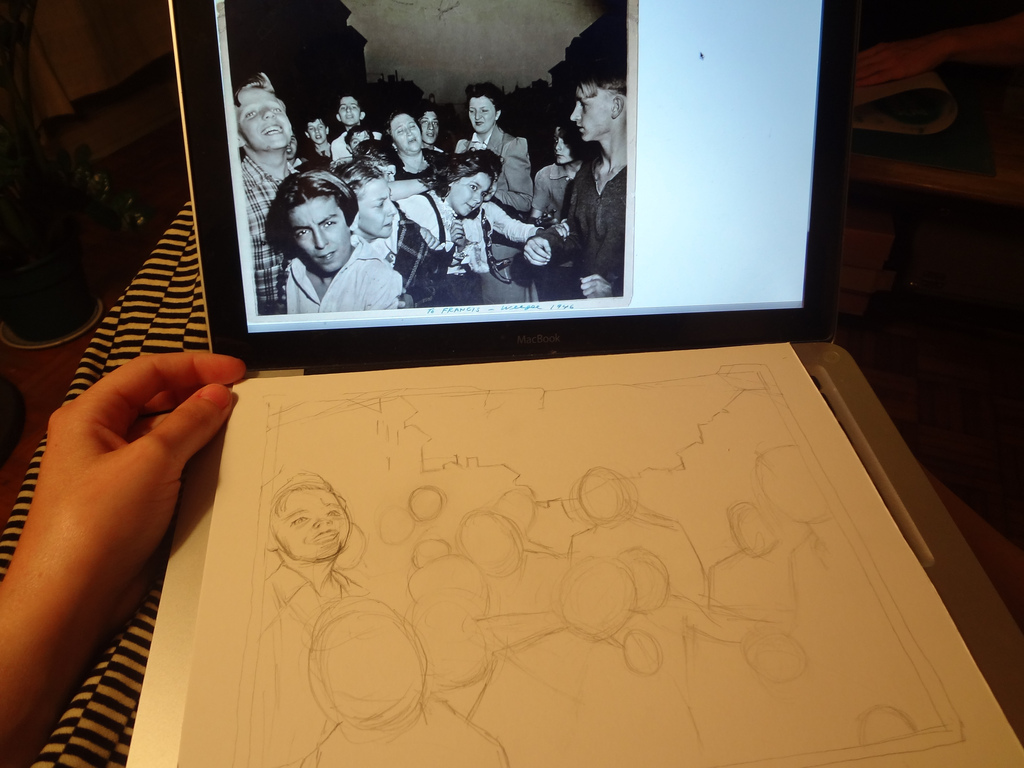
I waited until the 11th hour to start the drawing-- I was asked by MRR to contribute during what was possibly one of the busiest few weeks I've had in a long time with work, school prep, and other projects.  After breaking my brain trying to decide what to draw-- my brainstorm list included such grasps-at-straws as "cranes," "murder victims," "School Jerks outtakes," "Baltimore," "Google street view," "Kensington Market" and "mob scene"-- I finally settled on drawing American crime scene photographer Weegee's infamous snapshot, Their First Murder.


I first learned about Their First Murder a few years ago.  For those who don't already know the back story, for this photo Weegee for once chose to turn his camera not on a crime scene, but at a crowd who had gathered to look at one.  The photo depicts a range of emotions-- while a female relative of the victim cries, neighbourhood children rubberneck to catch their first glimpse of a dead man.  Shot during the latter half of the dirty thirties, the viewer imagines the gunshot victim as two-bit hood or mafioso-type.  Against the night sky, tenement housing looms heavily in the background.

To make the drawing sometime other than just a drawing of a photograph, I knew that the addition of a fitting caption of some sort would be key.  Initially, I wanted to have the caption relate to the children's reactions, tying them to the fact that punk-- to me, anyway-- has always been about confronting and embracing darker aspects of life as opposed to denying or turning away from them, as well as defying social conventions.  All of our lives, we are told to behave appropriately, and to not stare.  The children's reaction to the dead body in the photo is curious and essentially pure.

When I decided that all the captions I came up would sound a little too misanthropic for the good of the drawing, I decided to seek out a fitting quote instead.  The one I settled on is actually a portion of a poem written by a child in 1944 in the Terezin concentration camp, in what is now the Czech Republic under the tutelage of the artist-educator and possible pioneer of art therapy Friel Dicker-Brandeis.  I am glad this reference is obscure enough to prevent a heavy holocaust reading of the drawing, because that's was definitely not a part of my original intention-- the drawing is still of a bunch of kids in New York City shot by Weegee, after all.  The text is appropriate in that at its core is an allusion to creativity and resilience-- how creative acts are almost always concious or unconcious attempts at building an ideal world, against all odds.

Tuesday, May 01, 2012

Rochester Trip


Took a quick trip across the pond to Rochester, New York last week.  The weather was sort of craptastic (mostly cold and damp), but it was a really cool trip nonetheless.  Rochester is a tiny city, with lots of neat art deco/art moderne architecture.  The Kodak Building, the firehall on Chestnut Avenue and this old Chevrolet dealership (?) turned coffee shop in downtown Rochester's east end were highlights, for sure.


While I was there, I managed to take in a lot of art in both expected and unexpected places.  I went to the George Eastman House (Eastman was founder of Kodak, which is based in Rochester) which is a museum of photography and film situated in an old ivy-covered mansion.  There was an exhibition up which featured a number of photographic medallions from the early 20th Century such as the one above (scooped from the George Eastman House Flickr page).  There was another small exhibition called Ballyhoo, which focused on promotional materials and signage from the golden age of film and was particularly neat.  The one thing that irked me about Eastman House was it's lack of wayfinding information-- after leaving, we realized that we had missed two of the museum's exhibitions entirely.  Rats!


One of our other stops was the Rochester Contemporary Art Center, which had a great show up called Work It: Artists Address Labour and Unemployment.  It was nice to see pieces from Kathryn Clark's Foreclosure Quilt series up in this show, which I had only previously seen through images online.  Also got to meet the gallery's plucky Director, who introduced himself and chatted for a while.  Nice dude!  Don't think that's ever happened to me in Toronto...!


Our first night there, we ventured into the amazing abandoned Rochester Subway tunnel with the friend we were staying with armed with only a single flashlight and about $10 (goes a long way in the U.S.) worth of alcohol . Apparently people go down into the tunnel all the time to explore-- there was a ton of graffiti down there.  The above patch was particularly unusual.

This trip to Rochester made me miss Baltimore quite a bit, and reminded me how much smaller American cities have to offer.  Canadians generally want to go to places like New York City and San Francisco on vacation-- understandably so, but smaller American cities seem to really have their own unique identity and a slew of neat things to check out that can be found pretty easily.  I'm looking forward to going on more quick and dirty trips like this just south of the border in the future-- next up is Detroit, hopefully.

Sunday, December 18, 2011

Crime Map Walk

Crime Map Walk Crime Map Walk Crime Map Walk

Here are some photos from my final project for my Performance Art class.  The following text is my short artist statement about the project.

Crime Map Walk
Performance documentation from 10.12.11 
Video, laptop, paper, pins


This performance is inspired by the idea of the artist as traveler, responding to the city they find themselves in as well as walking tours and maps.  Its jumping off point was an online “crime map” of Baltimore, which one can consult to find an up-to-the-minute map and information indicating the locations and types of crimes committed across the city.  Before coming to Baltimore, I found myself browsing such maps as a way of attempting to distinguish between the “good” and “bad” parts of the city.  As any long-time resident of Baltimore knows, it is quite difficult to make such a distinction here, where there is a fairly high crime rate city-wide.


For this performance, I used the Baltimore Crime Map (http://crimebaltimore.com/) to trace a walking path between my house in Charles Village and a main intersection in the Inner Harbour.  I then walked this long path, trying to pass as many sites of recent crimes as possible, taking photo-documentation in the form of over 100 photographs taken every half-block or so along the way.  These photographs were then turned into a stop-motion style video, which serves as the main document of the performance.


This performance plays with the idea of how people respond to crime and fear in an urban environment.  As a defense mechanism, many people avoid areas they feel are “bad” in their day-to-day travels.  This performance reverses this logic, and in doing so, faces certain fears of crime head on.  Also, in performing this walk on a Saturday during the holiday season, I realized that hardly anyone was walking around on the streets I walked during my journey.  This performance also attempts to address the importance of street life and pedestrianism in keeping cities both lively and safe.